
Month/Year
- April 2026
- April 2024
- June 2023
- April 2023
- April 2022
- March 2022
- November 2021
- July 2021
- May 2021
- April 2021
- December 2020
- November 2020
- October 2020
- September 2020
- August 2020
- June 2020
- May 2020
- April 2020
- March 2020
- January 2020
- December 2019
- November 2019
- October 2019
- September 2019
- August 2019
- July 2019
- June 2019
- May 2019
- April 2019
- February 2019
- January 2019
- November 2018
- October 2018
- September 2018
- August 2018
- July 2018
- June 2018
- May 2018
- April 2018
Tag
- A Scowl Becomes Me
- Abuse
- Agent search
- Audio book
- August
- Authenticity
- AutoCrit
- Balance
- Blog
- Blurb
- Book design
- Books
- Books on writing
- Brandon Sanderson
- Character names
- Cover art
- Cultural appropriation
- Depression
- Dialogue
- Editing
- Emotion
- Expenses
- Fans
- Haruki Murakami
- ISBN
- InDesign
- Japan Writers Conference
- Japanese content
- Kintsugi
- Language
- Life in America
- Life in Japan
- Mental health
- Murder
- Muse
- NaNoWriMo
- National Novel Writing Month
- Neyuki
- Orpheus Insufficient
- Orson Scott Card
- Pandemic
- Pantsing
- ProWritingAid
- Publishing
- Punctuation
- Routine
- Scrivener
- Self-publishing
- Sequel
- Sexual abuse

National Novel Writing Month 2019 III
I won NaNoWriMo 2019, my second win in a row.
National Novel Writing Month (NaNoWriMo) is over—I won for the second straight year—and it is time to balance out my life again. I started a few days ago. My daily word count slowed down a week earlier because the text was over 80,000 words and I had told the story. I tried over a few days to just write a little, but it was hard not to let it consume me, and I struggled when it was time to change gears. So I focused more on my job. Still, I was tempted to tinker. So I have been filling things in, doing little bits of editing, adding metadata to the Scrivener file, etc. in the days since I finished the basic story. Now the word count stands at 95,700. I have a little to add in December, but otherwise the novel is ready to put on the shelf for a month or two before I start an edit. I don’t think, though, that it needs a major rewrite like last year’s NaNoWriMo novel did. That feels good.
National Novel Writing Month 2019 II
I passed the 50,000-word winning point of National Novel Writing Month on day 12.
I am in the middle of day 15 of National Novel Writing Month (NaNoWriMo) and I already won. In fact, I passed the 50,000-word winning point on day 12 and today I should reach at least 60,000. Last year it took me 15 days to win what is supposed to be a 30-day challenge. I don’t know if winning three days faster than last year shows that I’m getting better, though, or only more obsessed. Still, my life has not gone to pieces as I have sunk whole days into writing. (I found it helps to get up at 3 a.m. and write until early afternoon as if nothing matters except getting this novel into the computer.)
Whatever the reason behind my productivity, I am pleased with what is in my Mac. Editing will trim the text (I am wordy), but I will also fill in details to make a richer narrative. For example, I have not yet physically described any of the characters. Thus, it may not get shorter, although I am sure that I can make it much better. Still, in this first draft I’m discovering so much about the story. It has been interesting to figure out how the protagonist (an academic) meets the various antagonists (all yakuza). I had a basic idea for how the plot would develop, but my preconception had precious little detail for any but the beginning chapters. It is a great feeling when the story flows out and the characters’ arcs intersect in exactly the right ways.
Despite having won NaNoWriMo, there’s plenty of work left for the rest of November. I still need to write whole chapters. And I must fill in the many places where I wrote so quickly that I left holes in the text. (This also involves finding and watching all six seasons of The Sopranos.) I have not kept close track of the flow of time through the novel, and my two first-person narrators need distinct voices. Perhaps the most sensitive job is crafting the right response (or sequence of responses) when the protagonist finds his love interest is not the woman he believed her to be. There are months of work left to do. But this first draft is a “proof of concept.” So far, it works. I am eager to finish this draft and start the months of polishing.

National Novel Writing Month 2019
I am feeling both excitement at writing something new (my first new novel since NaNoWriMo last year), and trepidation over whether I can make the story work.
In 2018, I entered National Novel Writing Month (NaNoWriMo) and won. Winning does not mean I beat the other entrants. It is a challenge to write 50,000 words of a novel in 30 days, and I did it (75,100 words). I have signed up to do it again this year, and I am feeling both excitement at writing something new (my first new novel since NaNoWriMo last year), and trepidation over whether I can make the story work. The idea for this novel, The Keeper, is from 2014. I started on it a few times in the past, but could never get past the opening scenes. It begins with a man depressed to the point of being suicidal, but who fears the impact of his suicide on his children. So he decides to get himself murdered.
At first, I set the novel in the rural southwestern U.S. (in my wife’s hometown), but it did not seem dangerous enough. Plus, I had never lived there, so I did not know the setting intimately enough (although my wife could help with the characters and the flow of life there.) So I switched to the South Side of Chicago, where I lived years ago, a city that has no shortage of murders. But I realized I would need to write parts of the novel in a young, urban U.S. vernacular, and living in Japan, I did not think I could find the help to pull it off. So I set it in urban Tokyo, but faced the problem of the city being far too safe. I think I have solved the problem now, but certainty will come with writing. So far I have only notes and a short tag line: “What’s it take to get yourself murdered in Tokyo? Pretty damn much.”
Last year I started my NaNoWriMo novel two weeks early, but by the last days of November, with the 20,000 words I had written in October, I was 90,000 words in and running out of story. So this year I decided not to start the novel until November 1. If beginning The Keeper turns out to be difficult, as it did before, I will just have to push through it. The novel has been in my head too long and it’s time to get it into my computer.
With five novels written, I have no doubts about being able to produce 50,000 words. And from winning NaNoWriMo last year, I know I can write the requisite number of words each day for a month. The question is whether I will have time to do all the other things that November will require of me.

Cultural appropriation
We write better when we write what we know, but are we limited to only that?
I set my novels in Japan. I write Japanese characters. I write female characters. All of this, despite my being an American man. So am I guilty of cultural appropriation?
Cultural appropriation, while nothing new, has entered the public consciousness. Like the “Me Too” movement that has shamed so many harassers of women in recent years, we should have been attuned to the inappropriateness of cultural appropriation all along. It has always been a bad thing to do. But as a writer, how do I completely avoid it? We write better when we write what we know, but are we limited to only that? In the extreme, must we write only what we are and tell only we have experienced? (What I have experienced is Japan, for 25 years of my adult life.)
Cultural appropriation is the adoption of cultural elements of one culture by another. It is particularly controversial when it is a dominant culture appropriating from a minority culture. In Wikipedia, a contributor observes, “According to critics of the practice, cultural appropriation differs from acculturation, assimilation, or equal cultural exchange in that this appropriation is a form of colonialism: cultural elements are copied from a minority culture by members of a dominant culture, and these elements are used outside of their original cultural context—sometimes even against the expressly stated wishes of members of the originating culture.”
I do not feel that Western culture is superior or dominant to Japanese culture, although its influence is forceful. I cannot say that Western culture is winning some kind of culture war. The influence seems stable, the two cultural forces close enough to equilibrium that the Japanese are not lamenting that their culture is being swallowed by the West. In fact, some elements of Japanese culture have had profound influences on the West. A great example is the influence of Japanese woodblock prints on Vincent van Gogh. He covered his walls with them. He copied them, even tracing them onto his canvases. That was not cultural appropriation. It was appreciation and a heartfelt desire to emulate the beauty he saw. He wrote to his brother Theo in September 1888, “And we wouldn’t be able to study Japanese art, it seems to me, without becoming much happier and more cheerful, and it makes us return to nature, despite our education and our work in a world of convention.” In a later letter he wrote, “All my work is based to some extent on Japanese art.”
There are plenty of cases of misappropriation of Japanese culture, of course. A recent outrage was Kim Kardashian wanting to name her line of lingerie “Kimono.” Kardashian even tried to trademark the word, something that brought a strong response from the Japanese government. Some, incensed, adopted the hashtag “KimOhNo” on Twitter.
While I don’t think I am guilty of anything so objectionable, my writing about Japan still has a problem. I have not solved the issue from my 5 July 2019 blog post that I need greater native knowledge. I am a foreigner, and I will never know Japan like a native despite having spent so many years here. So I will continue to look for a native Japanese writing colleague.
On the narrower problem of cultural appropriation in my writing, I raised the issue with my closest Japanese friend, someone who has read some of what I have written. She said not to worry about it, that what I do doesn’t qualify as cultural appropriation. In the end, though, even if some feel that a foreigner writing about Japan involves some degree of cultural appropriation that cannot be eliminated, I will not stop writing novels. How else will the stories get out of my head?
Writing buddies
Perhaps what’s most important in a writing buddy is having someone who shares the same dream.
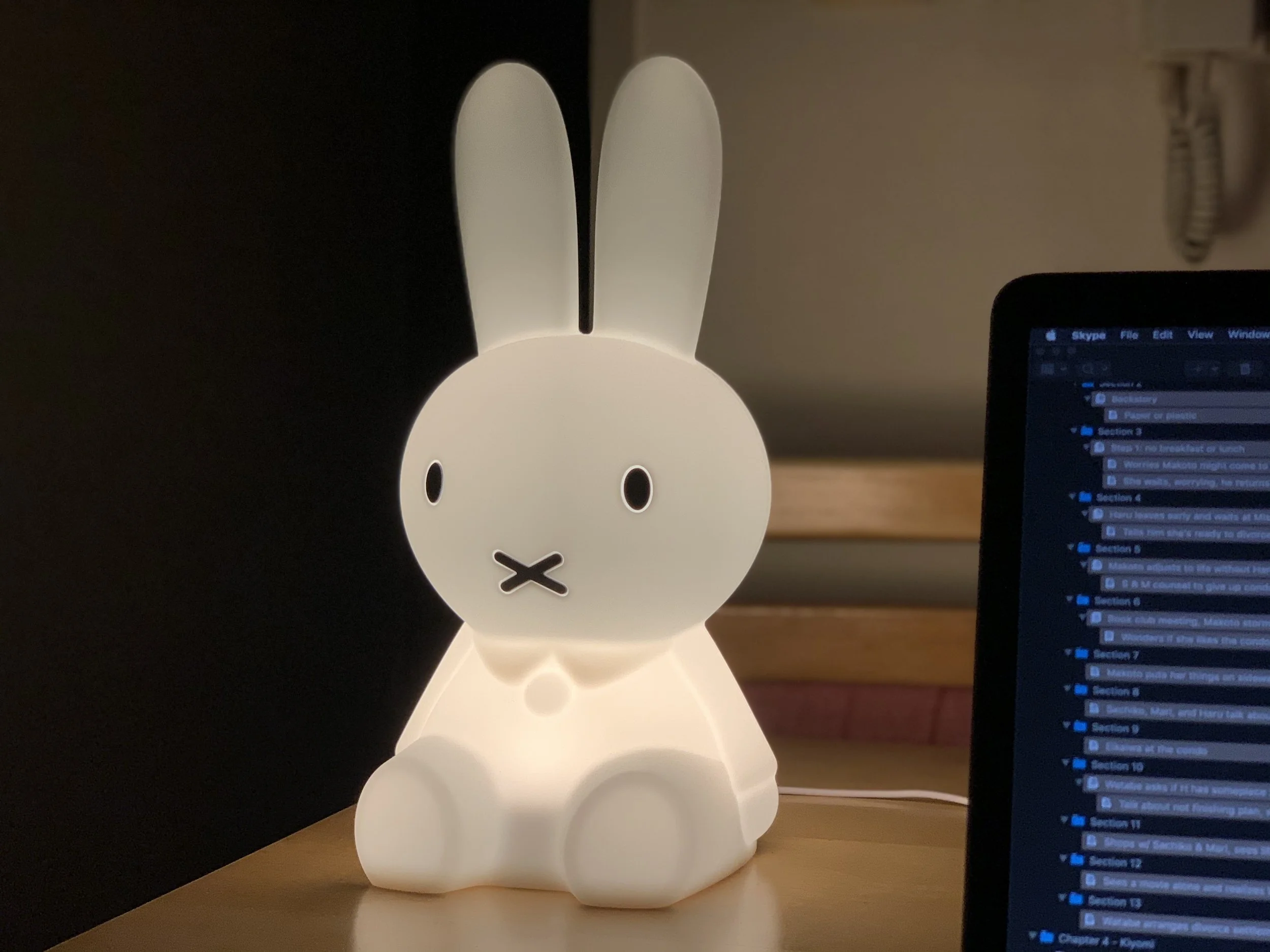
Do you have a writing buddy? Predawn is my favorite time to write. I enjoy the quiet of our small Tokyo apartment in those hours before the street outside begins to bustle. With my Mac set on “dark mode,” I leave most of the lights off. I do, however, turn Miffy on. We got Miffy as a nightlight for our toddler granddaughter, only to discover she already had one she liked. So now Miffy, always stoic, but with a glow so gentle and warm, serves as my early morning writing buddy.
Of course, it helps to have people who can talk back when you want to explore an idea. For that, my first and closest writing buddy is my wife. She is not writing something of her own, so in the strictest sense she is not a writing buddy. (Miffy doesn’t write much either, though she makes the morning more pleasant.) My wife is so involved in everything I write that it’s unusual for me to compose something without showing it to her. I cannot write first drafts strictly for myself, as Stephen King suggests. His wife sees second drafts he has cleaned up. My wife sees everything. She stays encouraging, though, telling me only that something “needs polishing,” not that it’s awful. I like to think it’s because I don’t do awful, but I trust my wife’s charity more than my talent. And when something works especially well, she tells me that too. Those are proud moments, for her judgment stands the test of time better than my own.
As far as writing buddies who do write, I have only one, my friend Jacinta. She’s an Australian who lives in Japan. I met her at a workshop she taught on printing and publishing in January 2018. It was there I began thinking about self-publishing my first novel. (My editor has since convinced me to try going the traditional publishing route, although it is slow enough that I expect I will lose patience before much longer.) In May 2018, I attended a weekend writing retreat Jacinta hosted. There, we agreed to exchange daily writing shout outs to keep each other motivated and writing every day for a month, for it is constancy to purpose that gets a novel written, not momentary genius. At the end of the month, we decided to do it again. That was a year and a half ago, and most days since then we’ve messaged each other with encouragement. She is out of the country now, so rather than another physical writing retreat, we have a three-hour virtual retreat early in the morning on the first Sunday of each month.
It’s interesting that Jacinta and I share little of what we write. Instead, we share our process and an optimism that if we keep writing, the process will create something worth publishing, for neither of us is writing purely for herself or himself. Maybe that’s what’s most important in a writing buddy, someone who shares the same dream. Jacinta does. My wife does too. And I trust Miffy does. She won’t say.

(Un)Inspired
Just write. As the words begin to flow out, the inspiration will finally come.
Two weeks ago, I wrote about my life lacking balance. All too often, writing is causing short shrift in other areas. The last couple of weeks, though, I’ve been under the gun at work. Ever obsessive, I’ve made great progress on what was pressing me, but in the process, I broke a daily writing streak that had lasted for eight months. I started a new streak yesterday. The bigger question, though, is what I will write for the next seven weeks. I have worked on all of the novels on my shelf recently enough that it is time to let them sit. I found as I tried to work through one last week that everything was too familiar. In editing, distance, at least a little, is essential. I do not want to start on a new novel until November. Besides, no ideas have me brimming with confidence. The obvious alternative in the meantime would be short stories. Unfortunately, I’m short of ideas there too.
I know the best way to deal with a block in writing is to simply write. As the words begin to flow out, the inspiration will finally come. Still, I’ve found that hard to do as my job pulls my thoughts away so constantly that writing becomes painful and frustrating. Nevertheless, I must write. After all, writers write, and if you don’t write, you’re not a writer. That realization inspires me to write each day, even the days that I am uninspired. So today I started a new short story. I do not have faith that the idea is good enough to make a great tale, but the writing will tell. And if this story is a weak one, at least it will give me more practice. And I do need the practice.

Balance
Balance: it’s so much more than an inner ear thing.
I’m writing about balance this week not because I have achieved it, but because I fail at it so miserably. Still, I realize how important it is. In fact, I struggle with it every day. I am just naturally obsessive in my work. It is difficult to get my mind wrapped all the way around a problem, and once it’s there, it’s also hard to tear it away. I can code a computer program for hours, forgetting to move, to eat, to take even a break to stand up and walk around, until I get so tired I can no longer understand the code I have written and tested. Writing is the same way. It winds through my mind like great tree roots, and while the result is not always worth keeping, the oneness with the characters and emotional connection with the story are wonderful to feel. It’s as if the tale is growing and leafing out right before my eyes. It’s no wonder that when it’s time to stop, even if the writing is tortured, it’s so hard to reel my mind back in and then sink it into something else.
Lately I’ve been doing even worse with balance than usual. I don’t know what the difference is. Neither does my psychiatrist. My monthly visits with him rarely take five minutes. I’ve told him things aren’t going very well. He doesn’t know what to change. I suspect he’s just happy I’m not depressed and doesn’t want to adjust anything that could send me into a tailspin. Above all, do no harm, right?
I also worry about the time invested in my writing not only by me, but by my wife, who is my first reader, first editor, and first critic. Reading and editing my work chews up too many hours of her weeks. She doesn’t complain—she’s a giver in every respect—but I don’t give enough in return. As I quoted Stephen King in the picture that goes with this post, “Life isn’t a support system for art. It’s the other way around.” My art makes my life richer, but does it enrich us enough? When I ponder that question, my response not being an obvious yes troubles me.
So I will keep questioning, keep trying to keep my balance, stand up straight, and not fall over as I feel my way along, keep holding on to the iron rod in faith that I’ll get stronger along the way—and keep an eye out for some great tales to tell.
Three more novels
I’ve been editing three more novels. I hope to introduce them here within the next few months.
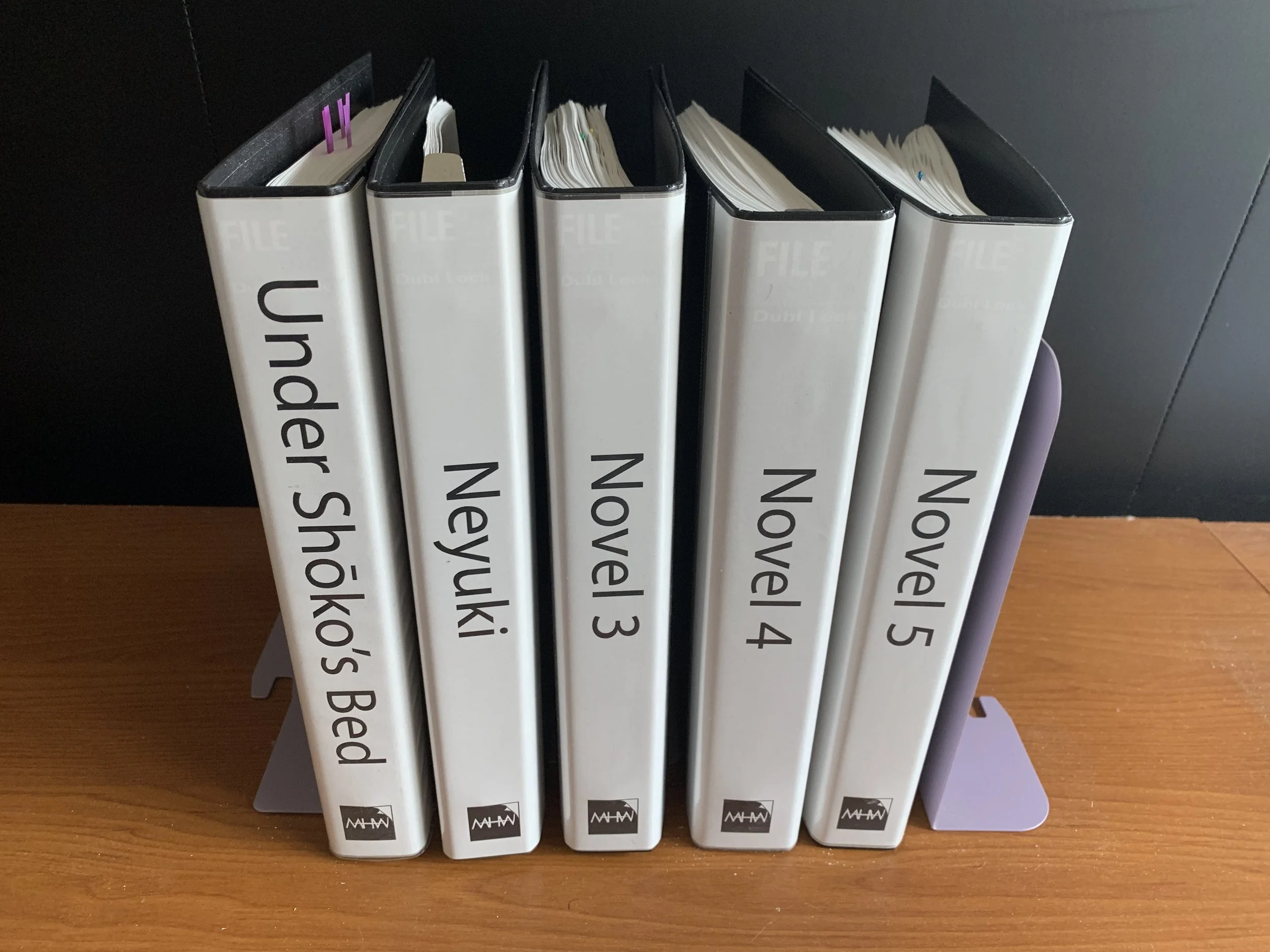
My first two novels, Under Shōko’s Bed and Neyuki, had been around for a long while before I opened this website last year, so I introduced them immediately. Neither had been through a professional edit, but both were well formed and unlikely to change fundamentally. My editor had me fix Under Shōko’s Bed for length, pacing, and some overwritting, not the basic storyline. Neyuki is with her now, and I hope the outcome will be similar.
I have three more novels, though, that are not as well developed. Since early May, I’ve been editing them. I started on them sequentially, but at times I have edited all three simultaneously. I have patched up holes and filled out thin spots. Novel 3 needs one more bit of story to make it satisfying. Besides wracking my brain, I am wheedling family and friends for the spark of that final idea. Novel 4 still needs research/expert knowledge to finish a few scenes. I know an expert. It’s time to make contact. Novel 5, last year’s NaNoWriMo novel, needed a new ending, which it has now. Each novel has places where I’ve written “FIX” in all caps, to mark (along with underscores) spots that need attention or are missing words. But those places are disappearing.
Despite the three novels approaching the point of asking others to read them, I am not adding them yet as “coming attractions” to this website. Validating feedback must come first. Each one needs editing for characteristics like symbolism and foreshadowing that will raise its literary quality. I also need to pay more attention to their voices. Announcing them is an exciting prospect, though, and it’s coming much more quickly than I expected even a few months ago. I’ve made breakthrough progress on all three in the time I thought it would take for just one.
It is going quicker partly because working simultaneously on three novels is not the confusing, scatterbrained experience I expected it to be. The content is all in my head. The voices are not all there yet, but I’m getting closer with that too. It’s been a great confidence builder.
In fact, I’m feeling buoyant enough that I am eager to start something fresh. Ideas draw my mind in new directions every day now. If all goes well, I may even do NaNoWriMo again this year.

Tears
It’s what leads up to the weeping, setting up the emotional situation, that is critical.
There is a famous quote from Orson Scott Card’s Characters and Viewpoint: “…if your characters cry, your readers won’t have to; if your characters have good reason to cry and don’t, your readers will do that weeping.” If the character does not show an emotional reaction, the reader will fill in what’s missing and feel it for them. This simple maxim is easy to follow, but is he correct or does a character’s display of emotion elicit a sympathetic response in the reader? Maybe I’m just a sucker for tears, maybe I mist over myself, but I have never found characters’ weeping could defuse the emotion I felt. The key, though, is the “I felt” part. It’s what leads up to the weeping, setting up the emotional situation, that is critical.
“Recent psychological theories of crying emphasize the relationship of crying to the experience of perceived helplessness,” says Wikipedia under “Crying.” If true, then a reader cries out of sympathy for a character caught in a trying situation. Unless they ease the trial, the character’s tears don’t make the reader feel any less helpless. In fact, insofar as weeping shows a character’s helplessness, it should heighten a reader’s emotions.
So what creates an experience of helplessness in a reader? It is always the writer’s aim to generate an emotional connection between reader and character. We must write characters who are real. They must react to their dramatic circumstances in a way that real people would react. They must be weak enough that the reader fears they will break or fail. Crying can be a realistic part of that drama. It is the drama that creates the reader’s emotions, though, not the weeping itself.
If crying is the experience of perceived helplessness, consider whether a character’s tears lessen or heighten that helplessness. If the reader identifies with the character and feels a connection, then the character’s helplessness should evoke a sympathetic response. The character’s tears should increase the reader’s emotion.
To move the reader, the weeping, as all writing, cannot be trite. Hackneyed writing’s clumsiness distracts the reader and breaks the spell. Cliches, though, aren’t the only distraction. Writing can get in its own way. Haruki Murakami wrote in Norwegian Wood:
One big tear spilled from her eye, ran down her cheek and splattered onto a record jacket. Once that first tear broke free, the rest followed in an unbroken stream. Naoko bent forwards on all fours on the floor and, pressing her palms to the mat, began to cry with the force of a person vomiting. Never in my life had I seen anyone cry with such intensity.
This description of crying evokes a vivid picture in my mind. It is not at all trite or cliched. However, I’m not moved by it. I find myself impressed by the words themselves, not touched by Naoko’s sorrow. Perhaps this was Murakami’s aim, since all the characters in Norwegian Wood come across as detached.
One final note: don’t let your characters cry too much. My first novel, Under Shōko’s Bed, places emotionally broken characters into scenes charged with feeling. Tears are a natural result. But my editor told me I went there too often. So I worked through the novel with sticky notes and marked all the pages with weeping. My editor was right. So I changed the characters’ reactions. They break down to the point of tears now only when the emotion in the scene is especially intense. The tears serve as markers of helplessness, and they move me.
So I disagree with Orson Scott Card. My emotions back me up. So do my tears.

Finding comparable titles
Under Shōko’s Bed is cross-cultural contemporary psychological literary fiction with mature characters set in Japan. Is that a category on Amazon?
If your novel can get a publisher’s attention, they will likely expect a list of comparable titles. I have been searching on my own and asking others who have read Under Shōko’s Bed for suggestions. I have yet to find any that are directly comparable in many respects, although there are some that are like Under Shōko’s Bed in one way or another. It is good for the novel to be unique. It may be harder to sell, though, when it cannot be pigeonholed, making its readership and profitability less predictable.
Spoiler alert! If you read the next paragraph, you may learn too much about the novel to most fully enjoy reading it.
Under Shōko’s Bed is a story of love and loss, and has strong elements of psychological pain. David suffers from depression and Shōko from post-traumatic stress disorder, and their healing influence on each other is a key part of their cross-cultural love story. Another important element of their recovery is Shōko leading David back to his true vocation, painting, something they shared when they loved each other many years before, but which David drifted away from in his life with his wife, Kelly. Unbeknownst to David and Shōko, however, they are part of a love triangle, as Kelly has not abandoned him as he thinks, but has only gone home to America. David, who has been too sick to leave the refuge of Shōko’s bedroom, has told no one where he is, and soon the police begin searching for him, and Kelly, now lost in worry, returns to Japan. It all comes to a head when Shōko’s parents suddenly discover David. He now has to make the impossible choice between the love he thought he had lost and the love he has just rekindled. Shōko must decide whether to fight for the man she loves or do her duty and step aside. Kelly too is faced with the awful choice of how to deal with David’s newfound love.
Under Shōko’s Bed is cross-cultural contemporary psychological literary fiction with mature characters set in Japan. Is that a category on Amazon?
The feedback I have gotten so far on Under Shōko’s Bed has led me to The Light Between Oceans by M. L. Stedman as one of the most comparable titles, since it has much the same sense of impending heartache. Strange Weather in Tokyo by Hiromi Kawakami, a tranquil Japanese love story in a confined setting, is another. Gabriel García Márquez’s Love in the Time of Cholera, and Nicolas Sparks’s The Notebook, stories of rekindling lost love, are two more. When We Collided by Emery Lord has broadly similar psychological themes, although it is about teens. I also feel some kinship with authors such as Barry Lancet, Micheal Pronko, and David Peace who have lived for an extended period in Japan and used Japan as a setting for novels (although they write in completely different genres from Under Shōko’s Bed).
Still, I have found no novel comparable to Under Shōko’s Bed in more than one or two aspects. My search continues.