Month/Year
- April 2026
- April 2024
- June 2023
- April 2023
- April 2022
- March 2022
- November 2021
- July 2021
- May 2021
- April 2021
- December 2020
- November 2020
- October 2020
- September 2020
- August 2020
- June 2020
- May 2020
- April 2020
- March 2020
- January 2020
- December 2019
- November 2019
- October 2019
- September 2019
- August 2019
- July 2019
- June 2019
- May 2019
- April 2019
- February 2019
- January 2019
- November 2018
- October 2018
- September 2018
- August 2018
- July 2018
- June 2018
- May 2018
- April 2018
Tag
- A Scowl Becomes Me
- Abuse
- Agent search
- Audio book
- August
- Authenticity
- AutoCrit
- Balance
- Blog
- Blurb
- Book design
- Books
- Books on writing
- Brandon Sanderson
- Character names
- Cover art
- Cultural appropriation
- Depression
- Dialogue
- Editing
- Emotion
- Expenses
- Fans
- Haruki Murakami
- ISBN
- InDesign
- Japan Writers Conference
- Japanese content
- Kintsugi
- Language
- Life in America
- Life in Japan
- Mental health
- Murder
- Muse
- NaNoWriMo
- National Novel Writing Month
- Neyuki
- Orpheus Insufficient
- Orson Scott Card
- Pandemic
- Pantsing
- ProWritingAid
- Publishing
- Punctuation
- Routine
- Scrivener
- Self-publishing
- Sequel
- Sexual abuse
Basing characters on friends
How does a real life friend feel when a character based on them does things they would never have done?
Where do authors find their characters? How do they choose their names? I often base mine on people I know, sometimes even leaving the whole thing intact. Students are a great source. Pick a first name from one student and a last name from another, and I have a character name that I know is perfectly realistic. I have to be careful, though, as my students are from all over the world, and mixing and matching in that pool can produce nonsense.
A few times I have chosen names, especially Japanese names, with the meaning in mind. “Ikenami” means “pond wave,” which as far as waves go, can hardly be a big one. It fit nicely for character that was a tempest in a teapot. In A Scowl Becomes Me, I wanted to name the protagonist’s wife Blessed. So then I named several of the Japanese characters with names that all mean “blessed.” I enjoyed having the protagonist learn the meanings of their names one by one.
More often, however, I choose Japanese names that are as different from each other as possible, as I know foreign readers can have a hard time keeping Japanese names straight. This was especially daunting in The Man Terror Club, as there are so many women and they are all important to the story. I purposefully tried to make them sound as different as possible, while still making them mainstream Japanese names.
I have also occasionally named characters I like after friends. It makes them more three dimensional for me. This can be even more true if the friend lends not only the name, but also the character’s personality or appearance. The female protagonist in my first novel, Under Shōko’s Bed, was inspired in part by experiences of a friend of mine (although it is mostly fictional). In The Time Well, I have based characters on a few friends. They have tentatively allowed me to use their full names, and seem to enjoy becoming part of the novel. I am planning the sequel now and one friend in particular is helping me understand how her character will react to the twists in the plot. The only real problem is that she is too busy to spend much time reading and giving me feedback.
The greatest problem with using friends to create characters is that I can never recreate the original person perfectly. So how does a real life friend feel when a character based on them does something they would never do? It has to be disconcerting. And that uncomfortable feeling could exceed the flattery of having one’s name or personality appear in the pages of a novel.
More importantly, I suspect all my characters are me. I am in there for good or ill. I wonder how my friends will feel about all being hybrids with me? I imagine our faces contorted and merged with Photoshop. It’s not pretty.
Perhaps the best way for me to think about it, though, is in line with advice I recently got from a friend who is a lawyer. I was wondering if the organizational setting for one of my novels, which is not at all flattering, could be close enough to a particular organization that I would wind up getting sued. My friend asked who the publisher was, and when I said I was self-publishing, he told me that I shouldn’t worry about it. He said that chances were no one would read it anyway.
Final lesson: some problems are more rhetorical than real. It’s important to keep things in perspective.
When do you write the sequel?
Somehow, the idea of a “part II” seems premature when I don’t even know whether anyone will like the first book. But it may be necessary to set up the sequel in the first novel.
Is it time to branch out into an all-new novel or march on with a sequel? I have several project ideas waiting in the wings, but I have also been making notes for sequels to two existing, but unpublished novels. Somehow, the idea of a “part II” seems premature when I don’t even know if anyone will like the first book. But I will likely need to have characters or situations that set up a sequel in the first installment of a series, which leaves me wondering whether the initial novels are truly finished.
This seems particularly important for my time travel series. While the world I have built does not allow looping back to the traveler’s starting point, it is still more complicated than a normal linear story line. I have already gone back into the first book and tweaked some facts based on my notes for the sequel. How much more will I need to change once I start the actual writing? The risk of omitting something critical to the later story makes me feel that having the complete series in front of me would be wise before I try to publish the first book.
I know popular authors write sequels long after publishing the first novel. There’s nothing to stop me from doing the same. I am creative enough to knit two stories together after the fact. But how much cleaner could the seams be if I sewed them up tight right from the start? Even straight-line stories depend on the original framework and setting of the story. Would it be best to stay immersed in the world I’ve created and spin another yarn? And how about a prequel?
Am I overthinking all this?
Writing the entire series before publishing any of it may be less important for novels where there are no backward time jumps. I’ve got more than one series started, so it might be useful to let a book sit for a while and work on something else before I write the next installment. It could also be better to stagger the writing and see if I get more perspective by waiting to move on with a storyline. But how many years does that turn into? I can write fast (not Stephen King fast, but fast enough), but as the unpublished manuscripts pile up, along with all the other work I need to do to get the novels to market (not to mention trying to build a customer base), the sequels could turn into a years-long quest.
But these incomplete stories tug on me. They nag so loud that they’re hard to ignore.
Damned whiney sequels.
Editing: Under Shōko's Bed III
I thought I sent Tricia Callahan a clean manuscript, but it turned out I had not learned the meaning of thorough.
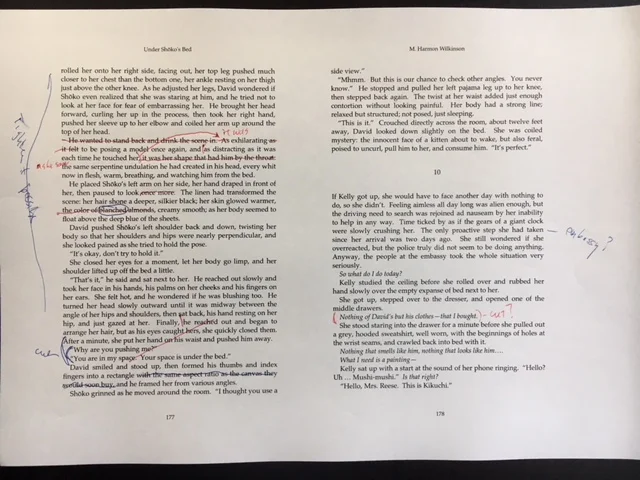
I thought I sent Tricia Callahan a clean manuscript of Under Shōko’s Bed to copyedit. I had stuck as closely as I could to The Chicago Manual of Style and had looked up all the spellings I was unsure of on the Merriam-Webster website. I was ready to give Tricia an easy payday. But it turned out I had not learned the meaning of thorough. Words I thought I knew turned out to be spelled wrong (e.g., police canvass a neighborhood, not canvas), I had too many echoed words, my punctuation was wanting (e.g., I thought I had fixed all the dialogue sections so that only dialogue tags connected to dialogue with a comma, but there were multiple places I had missed), among other problems.
By far the thing I had the most trouble with was punctuating italics. It is very difficult to know when the punctuation should match the italics of the sentence or phrase versus the roman of the surrounding text. I was able to glean some general principles from Tricia’s edit, though, and can use those to guide me in my other novels. Under Shōko’s Bed, though, is unique in my novels in its use of italics. There are imagined dialogues that use italics to help the reader know they are not actual dialogue. I doubt that I will ever have as much trouble with editing and italics again.
In all her thoroughness, Tricia was the consummate professional. She even created a “Style Sheet” for me to reference as I went through the changes. This included a list of characters, places, abbreviations, words she looked up, and a complete timeline of the scenes. Luckily, I had been very careful with the timeline as I wrote and there were no problems. I had even gone so far as to make sure that art exhibits, etc. in the characters’ pasts were real events. And in my behalf, I should say that most of the problems in the manuscript were small things that the average reader would never have noticed, but which would have driven me crazy when I finally found them. It’s nice to know there’s someone who can point them out to me so I can fix them.
Still, even with all of the problems Tricia found, it was not uncommon to go for pages between errors. In the end, I was able to input all the changes into Scrivener in a single day. So it was a very worthwhile edit. It’s a better manuscript now. Every writer deserves to be humbled. We need to be reminded that perfect text is almost always out of reach. The deeper humbling, though, will likely come when I self-publish the novel. I do not have readership locked in.
The idea: The Man Terror Club
Perhaps the most surprising experience of writing The Man Terror Club was how much I came to like the characters. While all the women have been betrayed, abused, or discarded, they remained kind, giving, and caring. Their love for each other heals them, and that healing is most of the story, not their terrorism as they lash out at the evil men do.
The idea for The Man Terror Club came to me as I was waking up one morning ten years ago. Who knows what odd places thoughts steal in from when you’re only half awake, but I wondered how an elevator operator might fight back if she was being sexually harassed. As my somnolent imagination meandered, it strayed toward acts of physical resistance and retribution, and the title The Man Terror Club popped into my head.
It may be the most evocative of all the titles I’ve written, but I worried about creating the story. That title deserved a brilliant book, and I wasn’t yet confident enough in my first two novels to believe they had prepared me to produce something of that caliber. I experimented with the idea in 2010-2012 as a short story, but I didn’t feel ready to write even that much.
So I waited.
I got more serious about writing in 2017. I rewrote Under Shōko’s Bed and Neyuki and improved both novels. How much more experience would I need before I could do justice to my idea? I thought it best to write at least two more novels before I tried The Man Terror Club. The problem was I didn’t have two other stories that moved me as The Man Terror Club did, so I finally resolved to just do it. In the spring of that year, over two months, I produced the first draft. I did not have the entire plot firmly in mind from the beginning, although I knew things would take a dark turn and end in murder. I envisioned each of the pre-murder chapters as a short story focused on a different member of the club. As I wrote, though, the women’s stories blended together and lost their short story flavor.
Still, each chapter for the first three-quarters of the novel is told first person from a different character’s point of view. (After that, narration stays first person, but already-introduced characters narrate sections of the chapters.) I didn’t realize at the time that I was flying in the face of writing pundits who warn neophytes and even more advanced writers never to write first person with a large cast of narrators. You should have few narrators and preferably only one. But what I attempted, eleven narrators, is not unheard of. William Faulkner used fifteen first-person narrators in As I Lay Dying. Of course, he won the Nobel Prize in Literature, while I remain unpublished. Nevertheless, I wanted to try.
Perhaps the most surprising experience of writing The Man Terror Club was how much I came to like the characters. While all the women have been betrayed, abused, or discarded, they remained kind, giving, and caring. Their love for each other heals them, and that healing is most of the story, not their terrorism as they lash out at the evil men do.
With my ongoing interest in the characters, I have even been bouncing the idea of a sequel around. I am taking notes and considering key characters, plot twists, and terrorist acts. I worry it may be premature to start a sequel before the first novel is even published. But The Man Terror Club, while not finalized, is just about ready for professional editing. I don’t think the fundamental story will change. And I want to spend a few months living with those women again. They are lovely people (who do extreme things), and more of their story ought to be told.
Editing: Neyuki II
I’m trying to write a whole new opening chapter. But bucolic life in rural Japan does not capture the imagination and refuse to let go. It doesn’t turn pages.
My editor, Fran Lebowitz, got the manuscript of Neyuki back to me a few weeks ago. It was a long time coming, but she gave me great feedback, including her overarching reaction: “I really loved the book.” I can satisfy most of her comments with simple revisions, but there are a couple of things that are more challenging to fix.
Fran would like to see the characters before the catastrophe that makes their lives spiral out of control. I had originally started with the momentous event, thinking that would be an effective hook. Based on her comment, I’m trying to write a whole new opening chapter. I am woefully dissatisfied, though, with the new beginning. Bucolic life in rural Japan does not capture the imagination and refuse to let go. It doesn’t turn pages. So day after day I peck away at ideas that may show the protagonist’s pleasant life in a way that can also hint at the coming conflict and keep readers going.
The longer term challenge for the novel is that it deals with sexual deviance and violence. Those are not the story’s principal themes, and the book condemns the characters who do those things, but they are integral to the plot. I know I risk triggering terrible thoughts, emotions, and memories for some, particularly survivors of sexual abuse. Some will say we should avoid such topics, that whatever worth the writing may have, it’s not important enough to overcome its degrading nature. Some worry about copycats. Those fears are not lost on me. But I know such deviance exists, I feel it’s good to denounce it, and I think Neyuki is a story worth telling. Yet I suspect no North American publisher will touch it. I could try to find a publisher in another country (the UK, for example), or I could publish it myself. Over time, though, the topic may become even less tolerable and the novel might forever stain me in some readers’ eyes. Even so, I’d like to find readers who will be moved by the story.
Whatever I decide, I hope to have a revised version of the novel completed this summer. It would be wonderful to publish it before the winter snows hit Japan.
Writing software: Two years with Scrivener
After writing with Scrivener for two years, I recommend it even more highly.
Are you wondering what to get for that writer on your holiday gift list? Get Scrivener from Literature and Latte. Your writer will thank you. Of course, it’s possible that they will find the software so useful that their writing hours will multiply and they will leave you with just scraps of their time as writing overwhelms another life. Software can be fraught with peril.
I last wrote about Scrivener in my 13 April 2018 blog post. I had been using it for two and a half months and was still learning how things worked. Now, nearly two years in, I know the software much better than I did back then, and I like it all the more. In 2018, everything I had in Scrivener I originally wrote in Apple’s Pages word processor. Now I have three complete novels written from scratch in Scrivener. It’s a great writing environment and a major boon to my creativity.
For me, Scrivener’s most useful feature is the “Binder” on the left side of the window. I think of it as an outline of the novel. I write each scene in Scrivener as a separate text file and the Binder organizes these hundreds of files into a simple hierarchical format. A title on each scene identifies it for me. The Binder lets me move things around and I often do. It also gives me the freedom to write non-linearly if that is how my muse is moving me that day. I can jump ahead and write things that come later. I can fill in the outline if I want to plot the novel in advance, or I can just add the scenes as they come if I am “pantsing” it. That freedom, together with easy organization, is a potent combination.
Another feature I love is the ability to assign Metadata to scenes. I add the date when each scene takes place and in some novels even the part of the day. It is wonderful for keeping track of the timeline and making sure everything works. I also add where the scene happens. I said in my blog post last April that I had even included the snow depth in each scene in my novel Neyuki, since it is important to the plot. I put in keywords that indicate the type of scene, symbolism, characters, etc. Then I can gather the scenes with a particular character or setting or scene type (e.g., dialogue scenes) so I can edit them for consistency. The flexibility is fantastic.
In my April 2018 post, after praising the software, I tempered my review with a significant drawback: “But—getting your work out of Scrivener can be a terrible pain.” I was referring to compiling the scenes into a manuscript, Epub, Mobi (Kindle), or other file format. There is a steep learning curve. It is not simple. But over time I solved my problems one by one and the formatting possibilities are powerful. So after working with the software for almost two years, I no longer feel that outputting from Scrivener is particularly painful.
But—I still do not trust Scrivener’s compiler to get the formatting perfect. For example, in a recent compile where I allowed hyphenation, Scrivener broke the word “wanting” after the “i,” so instead of “want-ing,” it gave me “wanti-ng.” I do not understand how such an error even makes it into a software program. Either someone at Literature and Latte messed up, or their lexicon includes a woeful error, or the user can customize hyphenation points (which would be a useful feature) and I accidentally did this. (I don’t think it was me, but if it was, there is no excuse for software being that easy to mess up.)
There are other little formatting problems. They are few and rarely pop up, but there are just enough that if I end up self-publishing, I will have to use layout software such as Adobe’s InDesign for the final formatting. I wish Scrivener had that capability and I could trust it and skip that final step, but that is a bridge too far.
So I recommend Scrivener as a gift to the writer in your life or yourself. Find a discount and buy it. Do it now. You will enjoy its organizing features, which I believe will unlock greater creativity in you. With a bit of learning, you’ll be able to output files in almost any format. And then, if you’re like me, when you’re done with all the writing and editing and you’re ready to publish, you’ll worry that the formatting isn’t perfect and you’ll take your output into something from Adobe.
Plotting or pantsing?
I have mostly “pantsed” my novels so far, but would a trilogy require more plotting in advance?
There is a long-running debate on whether “plotting” or “pantsing” is the better way to write. When “plotting” (or “planning”), you fully develop the outline of the story before you tell it. “Pantsing” (or “flying by the seat of your pants”) is starting the telling without preconceptions and letting the story take shape as it flows out.
The advantage of plotting is that you know the end from the beginning. Your writing is more directed, less haphazard. You can add foreshadowing and build in clever details that work seamlessly. The danger, though, is that the story can feel contrived, wooden, or forced as always knowing exactly where you’re going can make you ignore interesting creative avenues.
Pantsing gives your imagination free rein to go wherever the story moves you. Creating can feel more powerful and rewarding. But a pantser can wander, lose direction, and even end up stuck in a corner with nowhere to go. Imagine being 50,000 words into a project and then realizing it doesn’t work.
As an example, I was over halfway into my 2018 National Novel Writing Month (NaNoWriMo) novel when I realized it was turning into a simple love story, and I wanted something more complex. So I kept what I had, but added a thriller element. The problem was the new part of the story did not fit what I had written so far. I was pantsing the thriller element as well, and it started getting too fantastic. So I toned it down as I moved towards the novel’s conclusion, but again, the toned down section did not mesh with what came before. The novel ended up needing a significant rewrite, which I did months after NaNoWriMo ended. For this year’s NaNoWriMo novel, I did basic plotting but had some significant events only roughly in mind, and it came together as I pantsed almost all of it.
Is plotting more necessary for some topics than for others? Probably. If I wanted to write about time travel, with a story that loops back on itself, it would be easy to write myself into a dead end. But such a story might have all the more need for the creativity and spontaneity that comes from not having the story all worked out in advance.
It’s impossible to know in advance which approach will lead to a better outcome. I think it’s more a matter of personal taste. There are as many versions of plotting and pantsing as there are writers, and most people end up somewhere in between the two poles. I suspect many of the greatest pantsers are mental plotters. They may not have written down where they expect to go, but set ideas end up influencing the direction the story takes as it develops on the page. I also suspect the greatest plotters can write with a spontaneity that belies the fact that the story’s basic structure was worked out beforehand.
I am a confirmed “in-betweener,” but my process is much more pantsing than plotting. I want to see where the story is headed, but I enjoy the twists that appear in my pure flow of imagination as the story streams out line by line. As exciting as a plot twist may be for the reader, I doubt it can match the excitement for the writer as something never imagined appears on the page. It’s exhilarating!
Is pantsing just lazy? No, I think it’s simply hard for me to get my mind far enough into a story that I can anticipate every emotion, thought, and action of my characters without writing it.
So how far can pantsing go? I have pantsed six novels. Could it also work for a trilogy of novels? I am considering writing a longer work. I think I should plot enough to define the major twists. I would also decide on the breakpoints in the story at the end of the first and second novels in the three-novel series and the final ending. I would want the three novels to work together as a whole, and I worry I can’t pants a trilogy, so long and complex. At the same time, I’m sure once I start writing, the story will evolve. I don’t want to plot intricately only to throw it away.
The proof, though, will be in the writing. I guess this makes 2020 the year of biting off more than I might be able to chew.
Tears
It’s what leads up to the weeping, setting up the emotional situation, that is critical.
There is a famous quote from Orson Scott Card’s Characters and Viewpoint: “…if your characters cry, your readers won’t have to; if your characters have good reason to cry and don’t, your readers will do that weeping.” If the character does not show an emotional reaction, the reader will fill in what’s missing and feel it for them. This simple maxim is easy to follow, but is he correct or does a character’s display of emotion elicit a sympathetic response in the reader? Maybe I’m just a sucker for tears, maybe I mist over myself, but I have never found characters’ weeping could defuse the emotion I felt. The key, though, is the “I felt” part. It’s what leads up to the weeping, setting up the emotional situation, that is critical.
“Recent psychological theories of crying emphasize the relationship of crying to the experience of perceived helplessness,” says Wikipedia under “Crying.” If true, then a reader cries out of sympathy for a character caught in a trying situation. Unless they ease the trial, the character’s tears don’t make the reader feel any less helpless. In fact, insofar as weeping shows a character’s helplessness, it should heighten a reader’s emotions.
So what creates an experience of helplessness in a reader? It is always the writer’s aim to generate an emotional connection between reader and character. We must write characters who are real. They must react to their dramatic circumstances in a way that real people would react. They must be weak enough that the reader fears they will break or fail. Crying can be a realistic part of that drama. It is the drama that creates the reader’s emotions, though, not the weeping itself.
If crying is the experience of perceived helplessness, consider whether a character’s tears lessen or heighten that helplessness. If the reader identifies with the character and feels a connection, then the character’s helplessness should evoke a sympathetic response. The character’s tears should increase the reader’s emotion.
To move the reader, the weeping, as all writing, cannot be trite. Hackneyed writing’s clumsiness distracts the reader and breaks the spell. Cliches, though, aren’t the only distraction. Writing can get in its own way. Haruki Murakami wrote in Norwegian Wood:
One big tear spilled from her eye, ran down her cheek and splattered onto a record jacket. Once that first tear broke free, the rest followed in an unbroken stream. Naoko bent forwards on all fours on the floor and, pressing her palms to the mat, began to cry with the force of a person vomiting. Never in my life had I seen anyone cry with such intensity.
This description of crying evokes a vivid picture in my mind. It is not at all trite or cliched. However, I’m not moved by it. I find myself impressed by the words themselves, not touched by Naoko’s sorrow. Perhaps this was Murakami’s aim, since all the characters in Norwegian Wood come across as detached.
One final note: don’t let your characters cry too much. My first novel, Under Shōko’s Bed, places emotionally broken characters into scenes charged with feeling. Tears are a natural result. But my editor told me I went there too often. So I worked through the novel with sticky notes and marked all the pages with weeping. My editor was right. So I changed the characters’ reactions. They break down to the point of tears now only when the emotion in the scene is especially intense. The tears serve as markers of helplessness, and they move me.
So I disagree with Orson Scott Card. My emotions back me up. So do my tears.
Editing: Neyuki
I am both pleased and disturbed by how little of Neyuki’s content I sacrificed in whittling down the word count so significantly. It implies my original writing was wordy and repetitive.
In my blog post a month ago, I mentioned that I have been editing Neyuki, getting it ready to go to my editor in March. My goal was to cut it by 20 percent from 145,000 words. I think I am as close as I will come to that goal at 120,300 words (17 percent cut).
I am both pleased and disturbed by how little of Neyuki’s content I sacrificed in whittling down the word count so significantly. I hope it suggests my wife and I may be imaginative, expressive editors, but it also implies my original writing was wordy and repetitive. I am learning, though, and hope future writing will be both more efficient and more moving.
As with all but the broadest editing of Under Shōko’s Bed, I found it easier to work off of a printed version of the novel. It allows more deliberate, thoughtful changes to the text. One place I departed from that is in using ProWritingAid, a digital editor. Those changes, however, were smaller adjustments in wording. I plan to read through the novel (yet again) to make sure those edits do not affect the flow of the text, since most of the ProWritingAid alterations occurred without an extensive review of the surrounding text.
The edit has been time consuming as both my wife and I worked through the entire text twice (some sections much more) to save 25,000 words. We’ve been bereft of free time for the last two months. With this edit nearing completion, I am considering what comes next. First is another pass through Under Shōko’s Bed, since I am getting feedback from a second editor, Sadie Rittman (the daughter of the editor who worked on it last summer). I also suspect a window of opportunity will close soon for my fourth novel as a subject-matter expert will leave Japan this summer and easy access to his wealth of knowledge will disappear. The more daunting question with that novel is what bigger, deeper meaning I will offer to readers than the arcs of the various relationships, both loving and unfaithful.
It will be a momentous winter and spring! I hope I will be efficient too, since I have my third and fifth novels to whip into shape, and I still hope to create new content at the same time I am editing the old.
Routine
My goal is 1000 words per day, but editing tears me away from it.
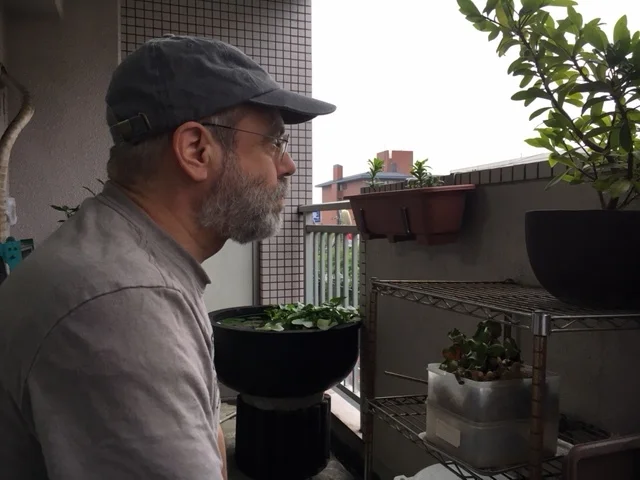
I haven’t been writing anything new lately. I’ve been engaged with writing; it’s just been editing instead of generating a new story. I’m missing the imagination that goes with writing something new.
It would be ideal if I could spend part of my time writing and part editing. The problem is that I have a regular job, so my overall writing time is less than I would like. An even bigger problem, though, is that I tend to work obsessively. I have to totally wrap my mind around something in order to be most productive, and once my thoughts are completely focused, it is extremely difficult to transition to anything else. So I work in spurts, first one thing and then another. It’s hard enough to go back and forth between work and writing, let alone to switch between writing a new story and editing an already written one.
So, given that difficulty making transitions, how do I keep motivated when I have to wait, or when I’m writing a new story and the writing gets difficult, the path ahead too dim to see? As simple as it sounds, one thing that keeps me moving is not ruining my unbroken streak of writing (or editing)—currently 175 days. Even stronger, though, is that I really enjoy my writing time. I don’t feel like a day is complete if it doesn’t include at least a little fiction.
When I’m writing a new story, my daily goal is 1000 words, and I set myself a minimum of 200. Sometimes I barely reach the minimum, and sometimes I get thousands. I try to keep perspective by using Stephen King’s daily word count as a yardstick: 2000 words. He is an unbelievably prolific writer. I find that if I can get a solid three to five hours to write, I can achieve his daily goal, but I don’t generally have that much time. So I decided that if I could be half as prolific as King (hence my 1000-word goal), I should count myself an unqualified success. He does his editing in the afternoon. Mine, on the other hand, tends to take the place of producing new stories, so I will likely not be half as prolific as King. I suppose I should be pleased to have a quarter of his output. (And I would be ecstatic with even a smidgen of a percent of his sales.)
King and other authors speak of the importance of a writing routine. They write at the same time, in the same place, each day. I generally get up very early and begin writing once I am fully awake, which happens by four or five a.m. I write at the kitchen table. Well, it used to be a kitchen table. Now it’s covered with computers and other random things (not all mine). We take our meals family reunion style sitting on the sofa and watching American politicians argue the country into … no, no, this isn’t a political blog. The most difficult part about writing at the table is that it’s in the middle of the house. Writing would be better in a little room with a door I could close. This is Japan, though, and the apartment is too small for that. It’s another reason to get up early: I get hours undisturbed.
So if you are ever wondering what it looked like for me to write one of these novels, just imagine me in my pajamas (surgical scrubs), sitting at a wee kitchen table, typing away obsessively on a 15” MacBook Pro. Average 1000 words per day for a hundred and some days and it turns into a whole novel. And then comes the editing.