Editing, Writing process M. Harmon Wilkinson Editing, Writing process M. Harmon Wilkinson

Editing: Under Shōko's Bed III

I thought I sent Tricia Callahan a clean manuscript, but it turned out I had not learned the meaning of thorough.

I thought I sent Tricia Callahan a clean manuscript of Under Shōko’s Bed to copyedit. I had stuck as closely as I could to The Chicago Manual of Style and had looked up all the spellings I was unsure of on the Merriam-Webster website. I was ready to give Tricia an easy payday. But it turned out I had not learned the meaning of thorough. Words I thought I knew turned out to be spelled wrong (e.g., police canvass a neighborhood, not canvas), I had too many echoed words, my punctuation was wanting (e.g., I thought I had fixed all the dialogue sections so that only dialogue tags connected to dialogue with a comma, but there were multiple places I had missed), among other problems.

By far the thing I had the most trouble with was punctuating italics. It is very difficult to know when the punctuation should match the italics of the sentence or phrase versus the roman of the surrounding text. I was able to glean some general principles from Tricia’s edit, though, and can use those to guide me in my other novels. Under Shōko’s Bed, though, is unique in my novels in its use of italics. There are imagined dialogues that use italics to help the reader know they are not actual dialogue. I doubt that I will ever have as much trouble with editing and italics again.

In all her thoroughness, Tricia was the consummate professional. She even created a “Style Sheet” for me to reference as I went through the changes. This included a list of characters, places, abbreviations, words she looked up, and a complete timeline of the scenes. Luckily, I had been very careful with the timeline as I wrote and there were no problems. I had even gone so far as to make sure that art exhibits, etc. in the characters’ pasts were real events. And in my behalf, I should say that most of the problems in the manuscript were small things that the average reader would never have noticed, but which would have driven me crazy when I finally found them. It’s nice to know there’s someone who can point them out to me so I can fix them.

Still, even with all of the problems Tricia found, it was not uncommon to go for pages between errors. In the end, I was able to input all the changes into Scrivener in a single day. So it was a very worthwhile edit. It’s a better manuscript now. Every writer deserves to be humbled. We need to be reminded that perfect text is almost always out of reach. The deeper humbling, though, will likely come when I self-publish the novel. I do not have readership locked in.

Read More
References, Books on writing, Editing M. Harmon Wilkinson References, Books on writing, Editing M. Harmon Wilkinson

The Chicago Manual of Style

Too often websites either disagreed or offered no helpful guidelines and I was having to decide on my own what grammar and punctuation rules to use. In addition, the sites didn’t cover many of the fine points, forcing me to make up too much. I needed a comprehensive style guide. So I adopted The Chicago Manual of Style.

I prefer having rules. It’s how things ought to be. There should be a right way to punctuate faltering or interrupted dialogue, to choose between toward or towards, or to know whether to make that last comma italic or Roman. (The answer is Roman.) So I made a major commitment a few weeks ago. I stopped looking up grammar, punctuation, and usage questions at what I hoped were trustworthy online sources. Too often those websites either disagreed or offered no helpful guidelines and I was having to decide on my own what rule to use. In addition, the sites didn’t cover many of the fine points, forcing me to make up too much. I needed a comprehensive style guide. So I adopted The Chicago Manual of Style.

I wish I had a good reason for waiting so long (especially since I am a University of Chicago alumnus). The CMOS is one of American English’s most accepted writing style standards. I suppose I thought it was mostly for dissertations and other academic papers. I was wrong.

It’s a major undertaking to look up all over again the myriad things I’ve wondered about. Plus, I just need to sit and read some sections of the book (perhaps at bedtime?). It will take a long time, but once I learn the Chicago rules of style, I won’t have to look up those answers so much anymore. The most difficult thing for me is punctuation, especially in italics or dialogue. Under Shōko’s Bed has far more italicized text than any of my other novels, so it has been hard to edit. Once I have mastered Chicago style, though, novels I write from then on will not need so many style interventions.

I just wish every topic in the CMOS had a single answer, even if it was context dependent. But some seem to have multiple acceptable styles or even conflicting advice in different sections. (I’m still not sure which numbers to spell out in dialogue, for example.) So some choices remain. Writing is all about choices, after all. In the pursuit of art, any rule is breakable as long as the breaking is purposeful. I’m the one at the computer, so the ultimate decisions are all mine. For stylistic choices, though, I wanted some help. With the CMOS next to me, I have somewhere authoritative to turn.

Read More
Self-publishing, Editing, Cover M. Harmon Wilkinson Self-publishing, Editing, Cover M. Harmon Wilkinson

A hermit's life

COVID-19 has rendered me a hermit. But the editor, cover artist, book designer, and proofreader I need are likely hermits too. Hermits unite!

I don’t have COVID-19 yet. Neither does anyone in my immediate family. Some are saying the U.S. will see a vaccine by Thanksgiving. That seems almost hopelessly optimistic. I’m not sure how Japan is doing on vaccines. My classes are all online, and the university has decided that will go on for the rest of the year. I am a hermit. It’s time to connect with some other hermits. It’s time to finish something.

I finished my first novel, Under Shōko’s Bed, months ago. For a long time, I was vacillating over whether to look for an agent and a publisher (as my editor suggested), or self-publish, as I had originally decided. A couple of things have made me shy away from the traditional publishing route. The first was the reaction I got to my first round of agent queries: silence. The second was my editor’s feedback on my second novel, Neyuki. It includes violence and sexual exploitation, and my editor doubted that in today’s climate, any American publisher would pick it up. It is also a book set in Japan, written by a foreigner (even though I’ve lived here for over twenty years, and if you should write what you know, Japan is what I know). I suspect interest in such books is narrow. A publisher is unlikely to want to squeeze into such a niche market. It’s also possible that even if someone took the book on, they would expect me to create buzz for it. If I will be creating the buzz anyway, I might as well just self-publish.

I want the book to be professional, though. I have worked with an experienced editor, but I still feel the need to hire a final copy editor—who is probably shut in somewhere because of this virus, a hermit like me. That will be expensive. Then there is the cost of hiring a cover designer, another likely hermit. This being my first novel, I would also prefer to work with someone on the book design, possibly a third hermit. Then I’ll need a fourth, a proofreader. None of these hermits will have taken vows of poverty, so all of this will push the cost high enough that I will almost surely lose money on the book.

It will be a great book, though.

So this month I plan to find a copy editor. Once the text is set, I will find someone to do a cover for it and possibly have the same person either do the interior or give me an InDesign template so I can do it myself. I want to get the book out in the fall. It will be a major challenge, as my other six novels are calling to me. There’s a lot to do. But when someone asks me how I spent my COVID isolation time, I will have a personal accomplishment to crow about.

Read More
Writing process, Editing M. Harmon Wilkinson Writing process, Editing M. Harmon Wilkinson

Editing: Neyuki II

I’m trying to write a whole new opening chapter. But bucolic life in rural Japan does not capture the imagination and refuse to let go. It doesn’t turn pages.

My editor, Fran Lebowitz, got the manuscript of Neyuki back to me a few weeks ago. It was a long time coming, but she gave me great feedback, including her overarching reaction: “I really loved the book.” I can satisfy most of her comments with simple revisions, but there are a couple of things that are more challenging to fix.

Fran would like to see the characters before the catastrophe that makes their lives spiral out of control. I had originally started with the momentous event, thinking that would be an effective hook. Based on her comment, I’m trying to write a whole new opening chapter. I am woefully dissatisfied, though, with the new beginning. Bucolic life in rural Japan does not capture the imagination and refuse to let go. It doesn’t turn pages. So day after day I peck away at ideas that may show the protagonist’s pleasant life in a way that can also hint at the coming conflict and keep readers going.

The longer term challenge for the novel is that it deals with sexual deviance and violence. Those are not the story’s principal themes, and the book condemns the characters who do those things, but they are integral to the plot. I know I risk triggering terrible thoughts, emotions, and memories for some, particularly survivors of sexual abuse. Some will say we should avoid such topics, that whatever worth the writing may have, it’s not important enough to overcome its degrading nature. Some worry about copycats. Those fears are not lost on me. But I know such deviance exists, I feel it’s good to denounce it, and I think Neyuki is a story worth telling. Yet I suspect no North American publisher will touch it. I could try to find a publisher in another country (the UK, for example), or I could publish it myself. Over time, though, the topic may become even less tolerable and the novel might forever stain me in some readers’ eyes. Even so, I’d like to find readers who will be moved by the story.

Whatever I decide, I hope to have a revised version of the novel completed this summer. It would be wonderful to publish it before the winter snows hit Japan.

Read More
Writing life M. Harmon Wilkinson Writing life M. Harmon Wilkinson

More distraction

With all this commotion, I admit I have to push hard to get past the distraction and lose myself in a story.

As summer approaches, my winter/spring distraction continues. As evidence, I wrote the first draft of this post over two months ago. Of course, it is odd that the COVID-19 pandemic has dictated that I stay home and work, when that is what I do most of the time anyway. I feel sympathy for those who are going stir crazy stuck in their homes, but I admit I am feeling none of that. I have stories to write, and I sit at my little table with my little computer and fill my extra hours tapping away on its keyboard oblivious, for a few hours at least, to the world.

My stories do not fill all my time. And the time they don’t fill is so tumultuous and upsetting. It disquiets me to watch the numbers steadily grow: infections, hospitalizations, critical cases, deaths. The restrictions on populations around the world, the unemployment, the economic pain are reaping a horrible toll. It’s hard not to pay attention, in the same way as a gruesome accident tugs at your eyes. Part of this pandemic, of course, seems quite accidental. People bear the blame for other parts, though. Some don’t follow instructions to practice social distancing or self isolation. Some assume they’ll come through it all just fine and don’t consider how those they in turn infect are going to come through it. Perhaps the worst are the few who could have led effective government responses, but were too vacuous or motivated by immediate political gain. They don’t seem to have the sense that there is a longer term problem. They have always gaslighted their way out of problems and assume that will be sufficient here too. It’s not. In democratic countries, such “leaders” can be voted out of office in disgrace. And those who don’t follow through on this weighty, consequential step will be failing us all.

With all this commotion, I admit I have to push hard to get past the distraction and lose myself in a story. But I have been able to push regularly enough to finish another novel and work on edits of a few more. The novel I’ve written isn’t about a pandemic, although a number of its characters die. I joked with a writing buddy that I should get a t-shirt that says, “I kill people. Wanna be next?” At least I am not dispassionate about it. After all, if there is no passion involved in losing characters, what were they doing in the story to begin with? Still, killing off characters at the same time that a pandemic is decimating the real world is sobering. 

I wonder how many pandemic stories are being created at this very moment by writers in scores of countries around the world. Their stories will ring with an immediacy they would not have had last year. Even though my writing isn’t immediate like that, I hope I can touch readers.

Read More
Writing life M. Harmon Wilkinson Writing life M. Harmon Wilkinson

Distraction

What do you do when you are too distracted to write?

Write anyway.

It has been a late winter of distraction. My primary care physician told me in the middle of February that the pain and bleeding from my kidney could be cancer. He followed that up with pathology supporting his assumption. (It was a middling stage of cancer, but I don’t know if the stages they use in Japan are the same as the stages in America.) He sent me to a urologist. The urologist did an ultrasound two weeks ago and said he didn’t think it was cancer. I just got the results of a CT scan two days ago. A kidney stone is causing the bleeding and pain (which is what I had suspected in the first place). My primary care physician is on my “Grrr” list, but I followed up on his concerns, which was the important thing.

So what do you do with your writing when mortality is close enough to feel its breath on your face (in my worst imagination this happened a lot)? What do you do when you are too distracted to write? 

Write anyway. 

I have two simple suggestions for that.

First, edit something old.

You can’t stop working, right? If you’re a writer, you write (or revise or at least edit). I sit down to write every day (and I succeed almost every time). I figured I was too distracted to lose myself in an invented world and populate it with characters, but I had novels that needed work, so I edited. It’s calming to sink your mind into a story you know like a comfortable old friend when you want to escape the prospect of death. Mortality also gave me a little kick to get things finished. 

It did not help much with the push to publish, though. That’s a lengthy process. Lengthy processes are not foremost priorities when you don’t know how much time you have left. (Yes, it’s sad to admit I was that concerned, but imagination is important for a writer, isn’t it?)

Second, write something new.

This week, I got to where I had nothing I needed to edit. It perplexed me, assuming I could never muster sufficient concentration to write anything new. But tried it anyway. It was an act of faith. (My wife’s constant upbeat attitude also took root.) 

And I wrote! I started only a handful of days before I got the “don’t worry about it” diagnosis, but I could write fresh scenes for Novel 7 each day. With a little extra push, I could force my way through the distraction, because the story is strong. I’ve been knocking the idea around for a couple of years, and I think I have worked out enough of the kinks that it’s realizable.

The one thing I did not attempt as I waited for test results was writing more blog posts. If you’re keeping up with the blog, though, don’t assume missing blog posts mean things are going badly. It also happens when I visit family at the holidays or get so wrapped up in writing I can’t tear myself away. The stories matter more to me than the commentary.

Read More
Editing M. Harmon Wilkinson Editing M. Harmon Wilkinson

Writing software: One year with ProWritingAid

ProWritingAid will help keep mistakes and clumsy wording from getting in the way of your writing. It will focus you on finding better ways to say things, and anyone can use such a push.
I want to update you on ProWritingAid, a writing tool I have been using. Last month I wrote about Scrivener from Literature and Latte and suggested that you get it if you are working on a long project like a novel. If you’re already using Scrivener, let me recommend that you follow it up with ProWritingAid. Although I have not done an exhaustive search, it is the best algorithmic editor I have found. Its ability to work with files in Scrivener format makes it much more useful than other tools such as Grammarly or AutoCrit.

Within days of first trying ProWritingAid a year ago, it impressed me enough that I bought a lifetime license.  Even starting out with that positive expectation, after using ProWritingAid and growing more familiar with its many functions, I rely on it more than I thought I would. I still use the Style, Grammar, and Overused Words reports more than the other tools. I also check Repeats and Echos looking for phrases I use more than once, which I often find, and Sentence Length, since I often write long ones.

Last year I said that many of the “errors” ProWritingAid flags will not be actual mistakes, and that hasn’t changed. Scrutinizing what it flags is wise, but it’s just an algorithm, not a program that understands what you’re saying. Sifting through the mistakes, your own versus ProWritingAid’s, can be a pain, but it’s also instructive. After using the program for these months, I trust it more than I did a year ago.

I don’t use it as I’m composing because it takes too much time to go through all its reports. I cannot imagine composing in ProWritingAid. It would be a constant distraction. I end up using it instead as I polish a manuscript before submitting it to an editor (human). Most of my writing has not gotten to that point, so I will use it even more heavily this year.

Please don’t assume that ProWritingAid or any other algorithmic editor will make your writing good. It will improve your work, but better than bad can still be far from good. There is no algorithm that can measure words’ ability to move you, and that’s what we are striving for. But ProWritingAid will help keep mistakes and clumsy wording from getting in the way. It will focus you on finding better ways to say things, and anyone can use such a push.

Read More
Editing M. Harmon Wilkinson Editing M. Harmon Wilkinson

Three more novels

I’ve been editing three more novels. I hope to introduce them here within the next few months.

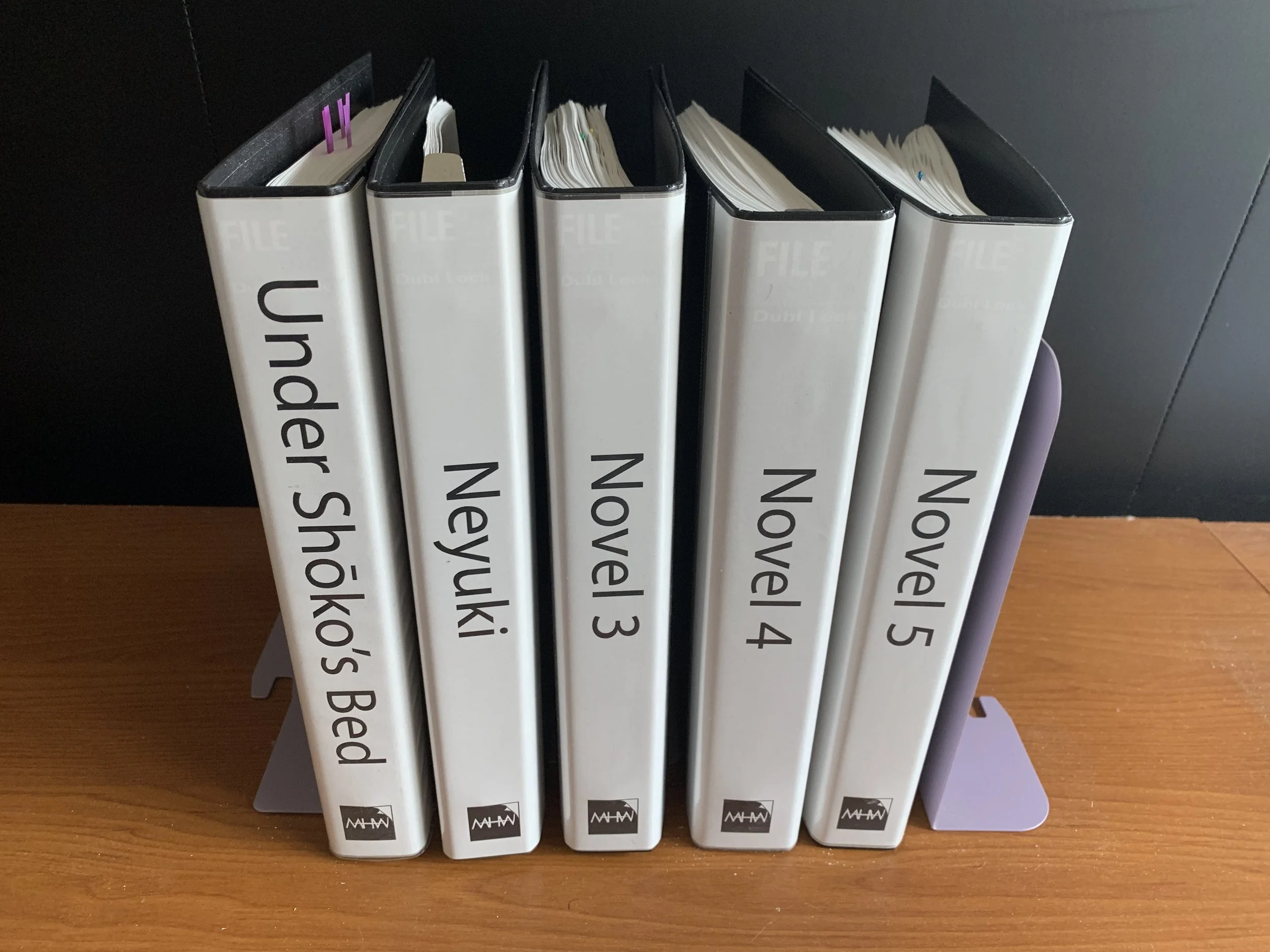
My first two novels, Under Shōko’s Bed and Neyuki, had been around for a long while before I opened this website last year, so I introduced them immediately. Neither had been through a professional edit, but both were well formed and unlikely to change fundamentally. My editor had me fix Under Shōko’s Bed for length, pacing, and some overwritting, not the basic storyline. Neyuki is with her now, and I hope the outcome will be similar.

I have three more novels, though, that are not as well developed. Since early May, I’ve been editing them. I started on them sequentially, but at times I have edited all three simultaneously. I have patched up holes and filled out thin spots. Novel 3 needs one more bit of story to make it satisfying. Besides wracking my brain, I am wheedling family and friends for the spark of that final idea. Novel 4 still needs research/expert knowledge to finish a few scenes. I know an expert. It’s time to make contact. Novel 5, last year’s NaNoWriMo novel, needed a new ending, which it has now. Each novel has places where I’ve written “FIX” in all caps, to mark (along with underscores) spots that need attention or are missing words. But those places are disappearing.

Despite the three novels approaching the point of asking others to read them, I am not adding them yet as “coming attractions” to this website. Validating feedback must come first. Each one needs editing for characteristics like symbolism and foreshadowing that will raise its literary quality. I also need to pay more attention to their voices. Announcing them is an exciting prospect, though, and it’s coming much more quickly than I expected even a few months ago. I’ve made breakthrough progress on all three in the time I thought it would take for just one.

It is going quicker partly because working simultaneously on three novels is not the confusing, scatterbrained experience I expected it to be. The content is all in my head. The voices are not all there yet, but I’m getting closer with that too. It’s been a great confidence builder.

In fact, I’m feeling buoyant enough that I am eager to start something fresh. Ideas draw my mind in new directions every day now. If all goes well, I may even do NaNoWriMo again this year.

Read More
Editing M. Harmon Wilkinson Editing M. Harmon Wilkinson

Voice

I began voicing my third novel. With eleven first-person narrators, it’s a daunting task.

I embarked on a new task this week. I began voicing my third novel. Although the first two novels have multiple points of view, I tell them in third-person and the voices of the narrators in the various points of view are similar. Novel 3, however, I tell in first-person using eleven narrators, all women. I feel they should all have unique voices, and it is a daunting undertaking.

I have found some excellent resources on the Internet. The one that helped me the most is from Jericho Writers. It goes beyond the normal platitudes and advice on how to find your voice and gives a list (admittedly not complete) of other “elements of voice” that you can manipulate in giving unique voices to characters. Here is a partial list of their partial list:

  • Rhythm

  • Length of sentences and paragraphs

  • Vocabulary

  • Lyricism versus realism

  • Humor

  • Warmth

  • Irony

  • Descriptive versus terse

Even before getting into the list from Jericho Writers, however, the character’s intelligence, personality, and attitude in the scene have an even greater impact on their voice. What I thought would be nearly impossible is starting off to great promise, with a wealth of variables available. And I am sure I can pull it off without resorting to creating a character that is too foul-mouthed. That’s just too easy, and I don’t want to be stale. How this whole process of voicing ends will be the proof, though. I will write again to share my insights. I hope to report that I gained a new skill and used it well, but that will be up to readers to judge.

Read More
Editing M. Harmon Wilkinson Editing M. Harmon Wilkinson

Owning it

After careful consideration of the feedback’s suggested alternatives, I found many of my original words were exactly what I wanted to say.
In April and May, I submitted my short story Papier Mâché to Tokyo Writers Workshop in two halves, since it was over the word limit for a single submission. I am thankful to all of the participants for their thoughtful comments on my work. Many of them had not submitted anything themselves, so we were not even trading feedback; these were simple gifts of time and effort. I went through all of the comments in detail. They seemed to disagree on almost every aspect of the story and how I should best deal with it. I made some changes, but nothing as drastic as some commenters had suggested. This felt somehow stubborn, as I have long believed that if a reader has something to say, I should be open to their opinions and question the words I’ve written.

I found this time, though, that after careful consideration of the alternatives, many of my words were exactly what I wanted to say. The more drastic feedback for Papier Mâché would have lost the message I wanted the story to tell. Some also would have changed the voice, which I like. So with confidence I am owning the story.

I am having very similar realizations as I go through the novels I am currently editing (novels 3 and 4): I like much of the content and the major rewrites I had anticipated are not turning out to be so drastic. What both novels are still missing, though, is the careful polishing that takes so much time. That’s what I truly want to own.


Read More