
Month/Year
- April 2026
- April 2024
- June 2023
- April 2023
- April 2022
- March 2022
- November 2021
- July 2021
- May 2021
- April 2021
- December 2020
- November 2020
- October 2020
- September 2020
- August 2020
- June 2020
- May 2020
- April 2020
- March 2020
- January 2020
- December 2019
- November 2019
- October 2019
- September 2019
- August 2019
- July 2019
- June 2019
- May 2019
- April 2019
- February 2019
- January 2019
- November 2018
- October 2018
- September 2018
- August 2018
- July 2018
- June 2018
- May 2018
- April 2018
Tag
- A Scowl Becomes Me
- Abuse
- Agent search
- Audio book
- August
- Authenticity
- AutoCrit
- Balance
- Blog
- Blurb
- Book design
- Books
- Books on writing
- Brandon Sanderson
- Character names
- Cover art
- Cultural appropriation
- Depression
- Dialogue
- Editing
- Emotion
- Expenses
- Fans
- Haruki Murakami
- ISBN
- InDesign
- Japan Writers Conference
- Japanese content
- Kintsugi
- Language
- Life in America
- Life in Japan
- Mental health
- Murder
- Muse
- NaNoWriMo
- National Novel Writing Month
- Neyuki
- Orpheus Insufficient
- Orson Scott Card
- Pandemic
- Pantsing
- ProWritingAid
- Publishing
- Punctuation
- Routine
- Scrivener
- Self-publishing
- Sequel
- Sexual abuse

Writing software: ProWritingAid
Human editors are a must, but an algorithmic editing tool can help you improve your writing before you send it to a real editor.
A couple of weeks ago I savaged AutoCrit. I was probably too harsh. It is a useful tool, despite the limitations I found. I still believe, though, that $30/month is too hefty a price for how much good it would do me. What if you could have the usefulness of an algorithmic editing tool, plus Scrivener compatibility, for $60/year (or less with a coupon code)? That sounds better to me, and that’s what I found in ProWritingAid. I have been using it for the last week, and it’s been worthwhile. This morning I bought a lifetime membership, which costs the same as three-and-a-half years at the yearly rate. I may not use it that long if artificial intelligence takes major leaps forward and ProWritingAid ends up lagging behind other tools, but it has impressed me enough that I am willing to take a chance.
ProWritingAid has over twenty different reports. I am finding the most useful to be spelling and grammar (it has caught a handful of errors that I hadn’t noticed on multiple read-throughs) checks of overused words, sentence structure and length, and style suggestions such as cutting adverbs and hidden verbs. One of my biggest challenges is to make my writing more concise. The myriad things ProWritingAid can flag help me reassess my writing and look for shorter, better ways to say the same thing. It doesn’t fix my writing; it spurs me to do it.
One report that I am a bit suspicious of is the “Sticky Sentences” report. It claims that writing that is too full of the 200 most common words is like glue; it slows the reader. I have, however, tried this out to flag sentences, and have actually found it to be helpful as it pushes me to use more active, meaningful, or precise vocabulary.
Of course, ProWritingAid is still an algorithmic tool, and as such, it is woefully dumb. Almost all of the grammar issues it highlights are not errors at all. In that sense, my disappointment in AutoCrit applies equally to ProWritingAid. It takes patience to sift through all of the non-mistakes in search of the few actual errors in the text. At least ProWritingAid is not charging me much for all the trouble.
In the end, ProWritingAid has one more significant advantage: it can open and save files in Scrivener format. That convenience makes all the difference.
I would never trust the scores that ProWritingAid gives as actual measures of the quality of my writing. Writing is art, and computers will never understand how words can move you. Human editors are a must. An algorithmic editing tool, however, can help you improve your writing before you send it to a real editor.

Writing software: AutoCrit
Don’t spend $30/month for AutoCrit. Spend $1 instead and try it out. It will make you all the more thankful that there are talented human beings who are actually willing to edit another person’s work.
National Novel Writing Month (NaNoWriMo) concluded a month and a half ago and I have not written a blog post since. I guess that level of daily output burnt me out. I finished the month with 75,100 words. Added to the 20,000 I had before NaNoWriMo started, the novel is over 95,000 words. It needs a major edit, including some fundamental changes. All of that will come later, though. I am letting it sit for now while I work on other things. Chief among those is editing Neyuki, trying to cut it by 20 percent before it goes to my editor in early March. In December I cut it from 145,000 words to 134,500. That leaves me 18,500 words shy of my goal. This may simply be a goal I don’t reach, although I am trying hard to cut at least another 10,000 words.
As I looked at the various sponsors of NaNoWriMo, one that intrigued me was AutoCrit. They offer an online editing program on a subscription basis ($30/month for the Professional plan, $80/month for the Elite plan). This week I signed up, since they offer a two-week trial for just $1. Knowing how lame online translators are, I was skeptical that an online, algorithm-based editor could be worth the money that AutoCrit is charging. That skepticism was well founded. While AutoCrit’s algorithms seem to be surprisingly sophisticated, they cannot begin to match the usefulness of a human editor. I think that might be true for even a poor human editor—and I have good ones. I have written about them before. The first one, my wife, is quite accomplished and does editing part time in addition to her day job as a teacher. The second, Fran Lebowitz, whom I found on Reedsy, is a professional with truly enviable client comments. (One of those is from me.) Compared to either of them, AutoCrit fails miserably.
I am not saying that AutoCrit is not useful. It told me that I start too many sentences with “and” and “but,” which is probably true. It also says that I overuse the words “just” and “even.” But it also told me about useless things, such as my use of clichés. For example, it said I use “on the table” too much. How else do you say, “She put her purse on the table”? That’s where algorithms fail. Language is far too complex for today’s algorithms to effectively understand or classify. Where AutoCrit fails, though, is not just its identification of writing problems using too-simple algorithms, but then using those results to give writing an overall score. Under Shōko’s Bed scored 74.9. Being a professor, I can’t help but see that in letter grade terms, and I refuse to believe that my novel rates nothing more than a C. AutoCrit needs to give up on the meta-analysis and just stick to the stuff where it’s actually useful, like counting sentences that start with “and” and “but.” Unfortunately, the simple stuff isn’t worth $30/month.
In conclusion, don’t spend $30/month for AutoCrit. Spend $1 instead and try it out. Do it because it will make you all the more thankful that there are talented human beings in this world who are actually willing to edit another person’s work. Then find one of those people. You won’t be sorry.

National Novel Writing Month III
I won! I beat the challenge and now have a draft of my fifth novel.
I won NaNoWriMo! I beat the 50,000-word challenge of National Novel Writing Month with a total of 75,100 words. With the writing I did in October, that gives me a 95,000-word draft of my fifth novel.

National Novel Writing Month II
I finished NaNoWriMo in only fifteen days, but the 50,000 words that came out feel like pieces of three different novels. I have a lot of work left to do.
National Novel Writing Month (NaNoWriMo) has been invigorating, but it has also taken a lot of time. I finished the thirty-day challenge of 50,000 words in only fifteen days, yesterday, because I have written on average over six hours per day. That is not a pace I can keep up forever. Interestingly, I am surprised that it has interfered with my work as little as it has. It has stopped some other things, though. I have made very little progress in my edit of Neyuki.
I did not have Vision More Glorious all plotted out before I started writing. All that I knew was that I wanted it all to be from the point of view of one first-person narrator (a new exercise for me), and that it would deal with a psychiatric outpatient who takes an experimental drug and has his vision dramatically changed. What flowed out first was a (hopefully) sweet love story. I found at the 30,000-word point of NaNoWriMo (50,000 words total, since I had 20,000 already in the dozen days before November began), that the love story was close to its climax and was leaving me wanting something more, so in the writing after that, it become a novel of suspense as well. Then at about the 45,000 word point, I found the suspense was getting out of hand and the whole thing was becoming too fantastic, and the ending thereafter became more lighthearted. I feel like I now have parts of three different novels. Over the next few weeks, I will get a better idea of what I want to do with what I have written and begin filling in the missing pieces of one of those three novels. I actually have two weeks of NaNoWriMo left. I hope to make some progress in that time.

National Novel Writing Month
When life gleams all too transcendent—outstripping even your most vivid imagination—how could things possibly end well?
The Japan Writers Conference inspired me to sign up for National Novel Writing Month (NaNoWriMo). The NaNoWriMo challenge is to write 50,000 words of a novel in 30 days, starting November 1. I actually started the novel a little bit early on October 19 and had 20,000 words by the end of the month, which is fine, because another 50,000 words will not complete it. The working title is Vision More Glorious, and it’s about a psychiatric patient who is given an experimental medication. As I wrote in the synopsis of the novel for NaNoWriMo, “When life gleams all too transcendent—outstripping even your most vivid imagination—how could things possibly end well?”
The writing these last two weeks has been challenging, but a lot of fun at the same time. It is my first “new story” writing since I started work on the big edit of Under Shōko’s Bed back in August. It feels good to be writing again, not just editing. I am trying, though, to edit each day as well, so I am also working on Neyuki. Add all of that to a full-time job and it has me wishing that days were a few hours longer. How about a nice, round number like thirty?
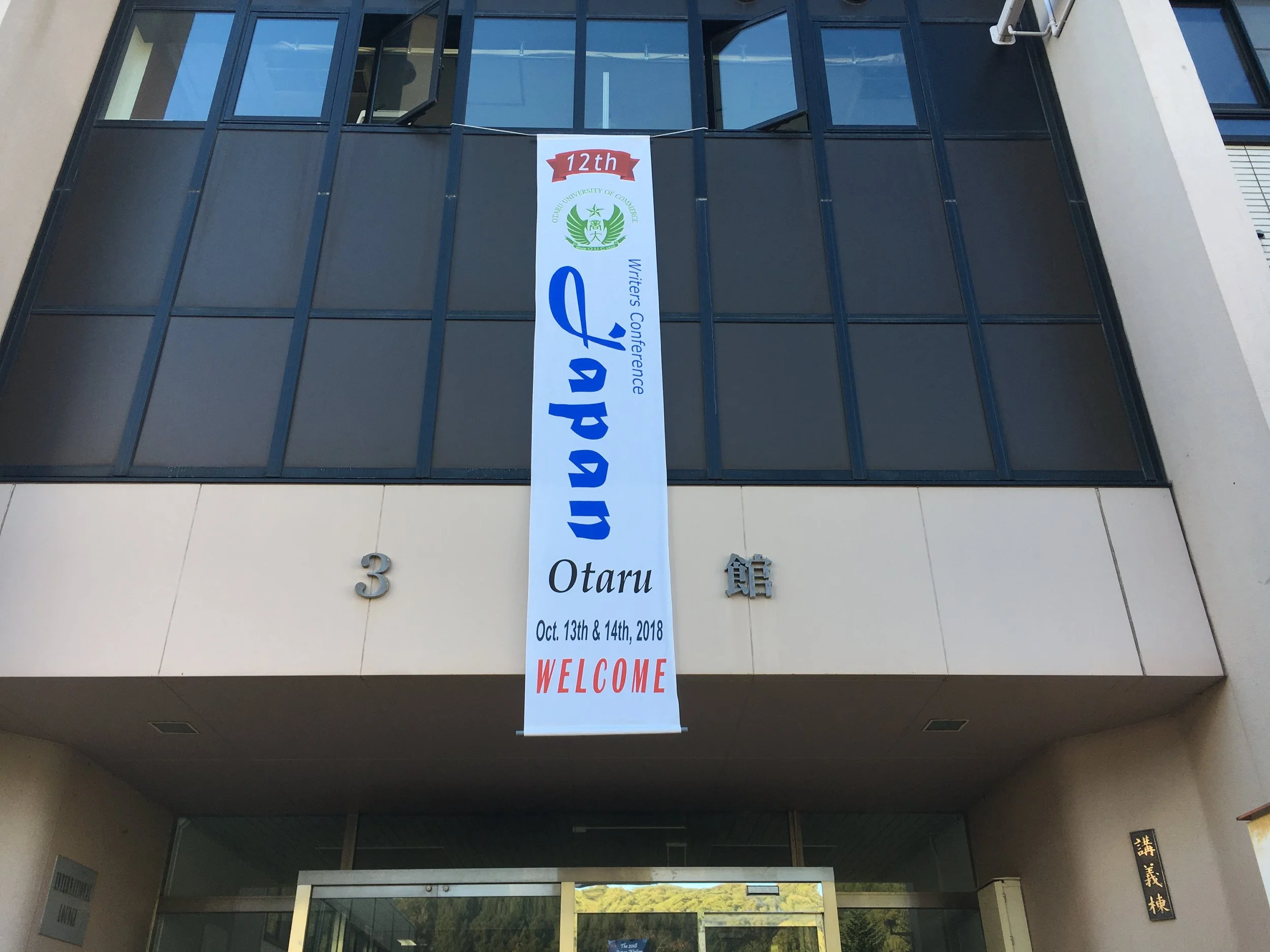
Japan Writers Conference 2018
The conference was intimate enough to make new friends and broad enough to learn new things. I came away inspired to be a better writer.
Last weekend, I attended the 2018 Japan Writers Conference in Otaru, a beautiful town in Hokkaidō on the Sea of Japan. My thanks go out to John Gribble and Karen McGee, the conference coordinators, and Shawn Clankie, our host at Otaru University of Commerce.
It was not a large conference. There were about forty sessions on three tracks. So it was big enough to get an interesting mix of topics, but intimate enough to see the same faces repeatedly, so that soon they were no longer strangers. I got to see Jacinta Plucinski and Chris Akiba Wang from Hackerfarm, reconnect with an old friend, Gregory Dunne, and make new friends like Warren Decker, David Gregory, Min Ku, Kai Raine, and Eric Selland. I met and talked with so many interesting people, and all were passionate like me, trying to become better writers, welcoming dialogue and feedback.
The sessions were excellent, but the one that may have the most lasting effect was Charles Kowalski’s on creating suspense. It so inspired me that I am now increasing the suspense, ratcheting up the tension, in my second novel, Neyuki. I think that is what the novel has been missing.
I look forward to having something published by the time the 2019 Japan Writers Conference rolls around. Perhaps I can make a presentation about the whole experience.

Routine
My goal is 1000 words per day, but editing tears me away from it.
I haven’t been writing anything new lately. I’ve been engaged with writing; it’s just been editing instead of generating a new story. I’m missing the imagination that goes with writing something new.
It would be ideal if I could spend part of my time writing and part editing. The problem is that I have a regular job, so my overall writing time is less than I would like. An even bigger problem, though, is that I tend to work obsessively. I have to totally wrap my mind around something in order to be most productive, and once my thoughts are completely focused, it is extremely difficult to transition to anything else. So I work in spurts, first one thing and then another. It’s hard enough to go back and forth between work and writing, let alone to switch between writing a new story and editing an already written one.
So, given that difficulty making transitions, how do I keep motivated when I have to wait, or when I’m writing a new story and the writing gets difficult, the path ahead too dim to see? As simple as it sounds, one thing that keeps me moving is not ruining my unbroken streak of writing (or editing)—currently 175 days. Even stronger, though, is that I really enjoy my writing time. I don’t feel like a day is complete if it doesn’t include at least a little fiction.
When I’m writing a new story, my daily goal is 1000 words, and I set myself a minimum of 200. Sometimes I barely reach the minimum, and sometimes I get thousands. I try to keep perspective by using Stephen King’s daily word count as a yardstick: 2000 words. He is an unbelievably prolific writer. I find that if I can get a solid three to five hours to write, I can achieve his daily goal, but I don’t generally have that much time. So I decided that if I could be half as prolific as King (hence my 1000-word goal), I should count myself an unqualified success. He does his editing in the afternoon. Mine, on the other hand, tends to take the place of producing new stories, so I will likely not be half as prolific as King. I suppose I should be pleased to have a quarter of his output. (And I would be ecstatic with even a smidgen of a percent of his sales.)
King and other authors speak of the importance of a writing routine. They write at the same time, in the same place, each day. I generally get up very early and begin writing once I am fully awake, which happens by four or five a.m. I write at the kitchen table. Well, it used to be a kitchen table. Now it’s covered with computers and other random things (not all mine). We take our meals family reunion style sitting on the sofa and watching American politicians argue the country into … no, no, this isn’t a political blog. The most difficult part about writing at the table is that it’s in the middle of the house. Writing would be better in a little room with a door I could close. This is Japan, though, and the apartment is too small for that. It’s another reason to get up early: I get hours undisturbed.
So if you are ever wondering what it looked like for me to write one of these novels, just imagine me in my pajamas (surgical scrubs), sitting at a wee kitchen table, typing away obsessively on a 15” MacBook Pro. Average 1000 words per day for a hundred and some days and it turns into a whole novel. And then comes the editing.
(Im)patience
Waiting—and editing—but still, waiting.
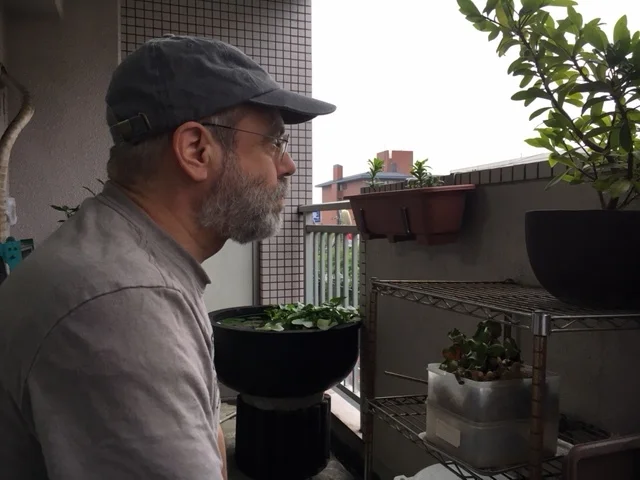
I am still editing Under Shōko’s Bed. The marks this time through are much fewer, though. Of course, I must eventually stop—and I want to; I have other projects. But I want this novel to be as good as I have in me. So four other people are reading it now. I gave out red pens along with the novel. I will have their feedback in a few weeks. I don’t know whether to hope for a lot of red ink.
In the meantime, I will finish my own edit, then read it through yet again, but more quickly, trying to judge the flow of the story and whether it drags. If I’m still waiting at that point, I will work through the text slowly—hopefully for the final time—looking for more of the problems William Strunk proscribes in The Elements of Style. One by one I am getting them into my head (appropriately updated for changes in American English in the last hundred years.) I wish I had a punctuation expert. I know the basic rules. I am into gray areas now that punctuation pundits on the Internet never mention. My wife tells me that in those situations I can simply decide, so I do. And I am careful to keep the punctuation all internally consistent. Still, I’d be more comfortable if there were rules.
As others read, I have to keep working. I don’t have the patience to simply wait. When I cut through all of this impatience, though, I am staring at the same difficult decision I have been facing all along: whether to self-publish. I had decided to do that, but my editor told me the story is good enough for a publishing house. Now I’m all up in the air again. If I self-publish, it’s time to be finding a book cover designer. If I go with a publishing house, I imagine they will handle that. But how long could it take to find a publisher?
More than anything, I hate the indecision. I am impatient to know what will happen. But it’s a journey, and I choose the path. So I will contact my editor again and get some advice on publishers. But when I do that, I would like to send an updated manuscript, and that means waiting for my readers to give me feedback.
Waiting—and editing—but still, waiting.
Editing: Under Shōko's Bed II
Editing is a painful process. It hurts to erase words that feel emotionally invested. But then you read it again, and the benefit shows. Under Shōko’s Bed is nearly complete.
I wrote two weeks ago about editing Under Shōko’s Bed. It has taken only a few weeks, but has been a very difficult process as I cut and cut and cut some more. The 7th draft was 107,700 words. The latest is 98,200.
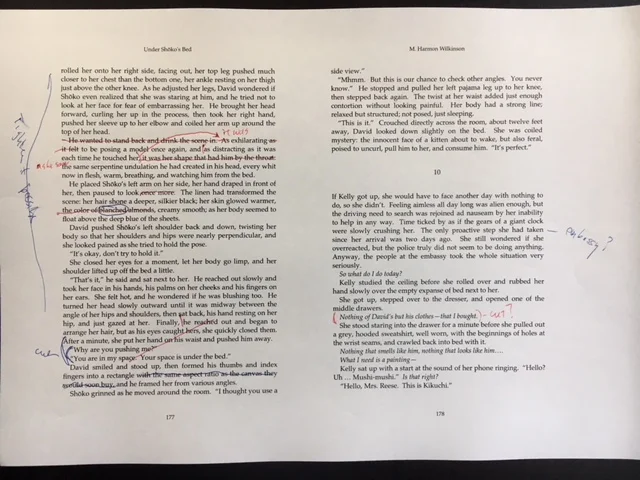
For cuts this difficult, I found it helped to print out the chapters and make the edits with a pen rather than working on the computer. The edits felt less final that way; each was just a “maybe.” With a whole chapter’s worth of edits, I went into the text in Scrivener, thought through the changes again, and made the ones that I still felt were good. In my last post, I mentioned Stephen King’s counsel that you have to be willing to “kill your darlings,” and this edit was exactly that. It hurt. And using a pen at first decreased the pain enough that I could make the cuts that much deeper.
Once I was done with all of the changes from my editor, Fran Lebowitz, (draft 8.0) I focused on shortening and worked with my live-in editor, Wallis. I have mentioned her editing skill before (The Decision to Self-Publish), but I saw it on full display once again. She is much better than I am at judging pacing. Her help was invaluable in making tech and art sections less didactic. She also has a gift for slashing unnecessary words. She used a blue pen, I used a red one, and the pages got pretty colorful.
Once Wallis was done, I went through William Strunk Jr.’s The Elements of Style and followed most of his prescriptions. I deleted scores of instances of “very.” I also deleted hundreds of adverbs. “Alright” became “all right.” I fixed “compared to” and “compared with,” “can” and “may,” and “like” and “as.” Then I went through the text to turn ellipses and em-dashes into commas, etc. That completed draft 8.1.
There are still a few things I need to check that will require a full read through. I doubt that I have split infinitives, but I should be sure. I need to examine my use of participles for verbal nouns. I need to read to see that participial phrases at the beginning of sentences refer to the grammatical subjects (Strunk’s rule 7), and that I have expressed coordinate ideas in similar form (Strunk’s rule 15) and kept related words together (Strunk’s rule 16), among other rules. That will be draft 8.2, but while that is in process, a few friends will read draft 8.1 and give feedback.
The editing is nearly done!

Editing: Under Shōko's Bed
If I want Under Shōko’s Bed to touch people, they have to read it, and my editor reinforced that the plot has to move, the tension has to increase and the pace has to quicken as the novel approaches its climax, and then it needs to end promptly.
I am in the process of a new (8th) draft of Under Shōko’s Bed, making the changes suggested by my editor, Fran Lebowitz. I found her through reedsy.com, a very useful platform. She has edited best-sellers, and before that spent years as a literary agent. The edit was a long time coming; I first contacted Fran in March, but she was booked up into July, so I waited four months. I waited because her testimonials were superlative. And it was a productive wait; I wrote the first draft of a whole new novel.
This is my first professional edit, so I was not sure what to expect. Fran’s editing process is a little old school, but it has worked well. I sent her a PDF manuscript of the novel. She printed it out (400 pages) and then sat down and worked through it, pen in hand. When she was finished, she scanned it and sent me a PDF of the manuscript with its handwritten notes.
I had imagined Fran telling me that my punctuation needed work, too many ellipses and em dashes, for example, and that I too often stray into passive sentence constructions. I thought every page would likely be marked up with myriad changes large and small. What I really feared, though, was that Fran would tell me, “Some people were never meant to write. Count yourself one of them.” Instead, she sent me a message halfway through the edit: “Hi, your writing is sublime! I’m making so few notes that my conscience is screaming at me. … I am so impressed and must say you do seem ready for prime time, no kidding.” She believes in my writing enough that she is willing to make introductions to agent and publisher contacts!
When Fran’s edit was finished, and I saw her notes, I found that most of my pages had no marks at all. It seems that my punctuation and grammar are actually quite good. And Fran did not try to change my voice. She did, though, have a few pointed criticisms about pacing, the treatment of the subject of depression, and an overabundance of tech and art detail. So now I am fixing things. I have cut the first and last chapters by 30 and 60 percent, respectively. That is still less than the 50 and 70-90 percent that Fran recommended. I have cut out a few scenes entirely. I have cut technical details. I am just starting the process of removing enough of the art content that the reader does not feel she is being subjected to an “art class.” The cuts so far total 7400 words, 7 percent of the novel. It’s hard, but I keep reminding myself of Stephen King’s words in On Writing: A Memoir of the Craft, “Kill your darlings, kill your darlings, even when it breaks your egocentric little scribbler’s heart, kill your darlings.”
With each cut, I can see the novel getting tighter. I loved the details, but the reader would not have. In the end, if I want Under Shōko’s Bed to touch people, they have to read it, and Fran reinforced that the plot has to move, the tension has to increase and the pace has to quicken as the novel approaches its climax, and then it needs to end promptly.
There is a lot more work to do. I’ll post again in two weeks to report how the rewrite is progressing.