
Month/Year
- April 2026
- April 2024
- June 2023
- April 2023
- April 2022
- March 2022
- November 2021
- July 2021
- May 2021
- April 2021
- December 2020
- November 2020
- October 2020
- September 2020
- August 2020
- June 2020
- May 2020
- April 2020
- March 2020
- January 2020
- December 2019
- November 2019
- October 2019
- September 2019
- August 2019
- July 2019
- June 2019
- May 2019
- April 2019
- February 2019
- January 2019
- November 2018
- October 2018
- September 2018
- August 2018
- July 2018
- June 2018
- May 2018
- April 2018
Tag
- A Scowl Becomes Me
- Abuse
- Agent search
- Audio book
- August
- Authenticity
- AutoCrit
- Balance
- Blog
- Blurb
- Book design
- Books
- Books on writing
- Brandon Sanderson
- Character names
- Cover art
- Cultural appropriation
- Depression
- Dialogue
- Editing
- Emotion
- Expenses
- Fans
- Haruki Murakami
- ISBN
- InDesign
- Japan Writers Conference
- Japanese content
- Kintsugi
- Language
- Life in America
- Life in Japan
- Mental health
- Murder
- Muse
- NaNoWriMo
- National Novel Writing Month
- Neyuki
- Orpheus Insufficient
- Orson Scott Card
- Pandemic
- Pantsing
- ProWritingAid
- Publishing
- Punctuation
- Routine
- Scrivener
- Self-publishing
- Sequel
- Sexual abuse
(Im)patience
Waiting—and editing—but still, waiting.
I am still editing Under Shōko’s Bed. The marks this time through are much fewer, though. Of course, I must eventually stop—and I want to; I have other projects. But I want this novel to be as good as I have in me. So four other people are reading it now. I gave out red pens along with the novel. I will have their feedback in a few weeks. I don’t know whether to hope for a lot of red ink.
In the meantime, I will finish my own edit, then read it through yet again, but more quickly, trying to judge the flow of the story and whether it drags. If I’m still waiting at that point, I will work through the text slowly—hopefully for the final time—looking for more of the problems William Strunk proscribes in The Elements of Style. One by one I am getting them into my head (appropriately updated for changes in American English in the last hundred years.) I wish I had a punctuation expert. I know the basic rules. I am into gray areas now that punctuation pundits on the Internet never mention. My wife tells me that in those situations I can simply decide, so I do. And I am careful to keep the punctuation all internally consistent. Still, I’d be more comfortable if there were rules.
As others read, I have to keep working. I don’t have the patience to simply wait. When I cut through all of this impatience, though, I am staring at the same difficult decision I have been facing all along: whether to self-publish. I had decided to do that, but my editor told me the story is good enough for a publishing house. Now I’m all up in the air again. If I self-publish, it’s time to be finding a book cover designer. If I go with a publishing house, I imagine they will handle that. But how long could it take to find a publisher?
More than anything, I hate the indecision. I am impatient to know what will happen. But it’s a journey, and I choose the path. So I will contact my editor again and get some advice on publishers. But when I do that, I would like to send an updated manuscript, and that means waiting for my readers to give me feedback.
Waiting—and editing—but still, waiting.
Editing: Under Shōko's Bed II
Editing is a painful process. It hurts to erase words that feel emotionally invested. But then you read it again, and the benefit shows. Under Shōko’s Bed is nearly complete.
I wrote two weeks ago about editing Under Shōko’s Bed. It has taken only a few weeks, but has been a very difficult process as I cut and cut and cut some more. The 7th draft was 107,700 words. The latest is 98,200.
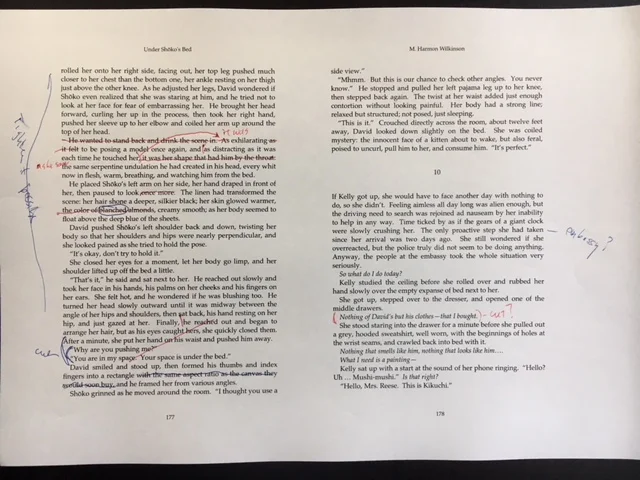
For cuts this difficult, I found it helped to print out the chapters and make the edits with a pen rather than working on the computer. The edits felt less final that way; each was just a “maybe.” With a whole chapter’s worth of edits, I went into the text in Scrivener, thought through the changes again, and made the ones that I still felt were good. In my last post, I mentioned Stephen King’s counsel that you have to be willing to “kill your darlings,” and this edit was exactly that. It hurt. And using a pen at first decreased the pain enough that I could make the cuts that much deeper.
Once I was done with all of the changes from my editor, Fran Lebowitz, (draft 8.0) I focused on shortening and worked with my live-in editor, Wallis. I have mentioned her editing skill before (The Decision to Self-Publish), but I saw it on full display once again. She is much better than I am at judging pacing. Her help was invaluable in making tech and art sections less didactic. She also has a gift for slashing unnecessary words. She used a blue pen, I used a red one, and the pages got pretty colorful.
Once Wallis was done, I went through William Strunk Jr.’s The Elements of Style and followed most of his prescriptions. I deleted scores of instances of “very.” I also deleted hundreds of adverbs. “Alright” became “all right.” I fixed “compared to” and “compared with,” “can” and “may,” and “like” and “as.” Then I went through the text to turn ellipses and em-dashes into commas, etc. That completed draft 8.1.
There are still a few things I need to check that will require a full read through. I doubt that I have split infinitives, but I should be sure. I need to examine my use of participles for verbal nouns. I need to read to see that participial phrases at the beginning of sentences refer to the grammatical subjects (Strunk’s rule 7), and that I have expressed coordinate ideas in similar form (Strunk’s rule 15) and kept related words together (Strunk’s rule 16), among other rules. That will be draft 8.2, but while that is in process, a few friends will read draft 8.1 and give feedback.
The editing is nearly done!

Editing: Under Shōko's Bed
If I want Under Shōko’s Bed to touch people, they have to read it, and my editor reinforced that the plot has to move, the tension has to increase and the pace has to quicken as the novel approaches its climax, and then it needs to end promptly.
I am in the process of a new (8th) draft of Under Shōko’s Bed, making the changes suggested by my editor, Fran Lebowitz. I found her through reedsy.com, a very useful platform. She has edited best-sellers, and before that spent years as a literary agent. The edit was a long time coming; I first contacted Fran in March, but she was booked up into July, so I waited four months. I waited because her testimonials were superlative. And it was a productive wait; I wrote the first draft of a whole new novel.
This is my first professional edit, so I was not sure what to expect. Fran’s editing process is a little old school, but it has worked well. I sent her a PDF manuscript of the novel. She printed it out (400 pages) and then sat down and worked through it, pen in hand. When she was finished, she scanned it and sent me a PDF of the manuscript with its handwritten notes.
I had imagined Fran telling me that my punctuation needed work, too many ellipses and em dashes, for example, and that I too often stray into passive sentence constructions. I thought every page would likely be marked up with myriad changes large and small. What I really feared, though, was that Fran would tell me, “Some people were never meant to write. Count yourself one of them.” Instead, she sent me a message halfway through the edit: “Hi, your writing is sublime! I’m making so few notes that my conscience is screaming at me. … I am so impressed and must say you do seem ready for prime time, no kidding.” She believes in my writing enough that she is willing to make introductions to agent and publisher contacts!
When Fran’s edit was finished, and I saw her notes, I found that most of my pages had no marks at all. It seems that my punctuation and grammar are actually quite good. And Fran did not try to change my voice. She did, though, have a few pointed criticisms about pacing, the treatment of the subject of depression, and an overabundance of tech and art detail. So now I am fixing things. I have cut the first and last chapters by 30 and 60 percent, respectively. That is still less than the 50 and 70-90 percent that Fran recommended. I have cut out a few scenes entirely. I have cut technical details. I am just starting the process of removing enough of the art content that the reader does not feel she is being subjected to an “art class.” The cuts so far total 7400 words, 7 percent of the novel. It’s hard, but I keep reminding myself of Stephen King’s words in On Writing: A Memoir of the Craft, “Kill your darlings, kill your darlings, even when it breaks your egocentric little scribbler’s heart, kill your darlings.”
With each cut, I can see the novel getting tighter. I loved the details, but the reader would not have. In the end, if I want Under Shōko’s Bed to touch people, they have to read it, and Fran reinforced that the plot has to move, the tension has to increase and the pace has to quicken as the novel approaches its climax, and then it needs to end promptly.
There is a lot more work to do. I’ll post again in two weeks to report how the rewrite is progressing.
Books on writing: William Strunk Jr.
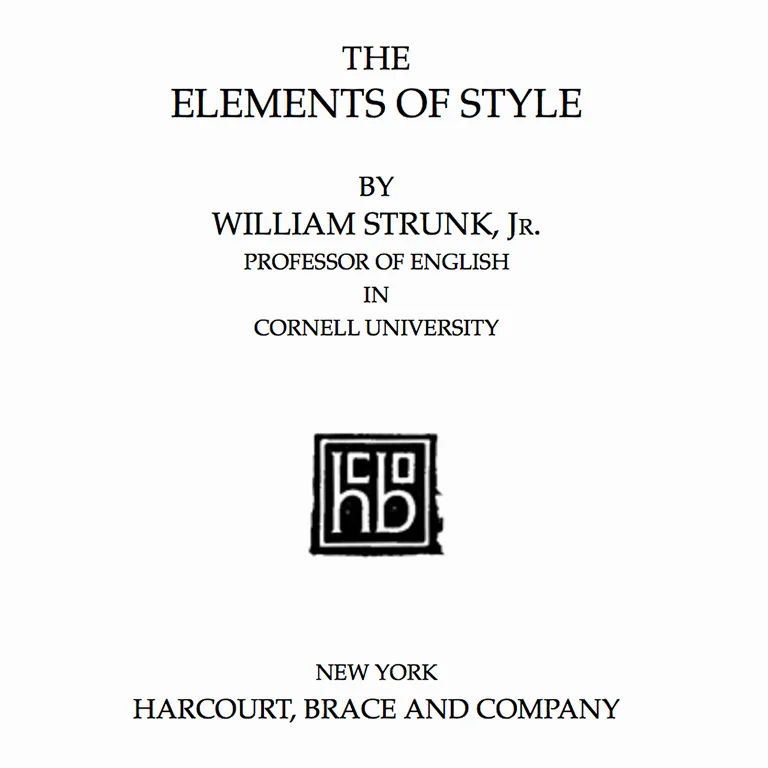
William Strunk Jr.’s The Elements of Style, a classic reference for writers, brims with useful advice, but at 100 years old, is any of it archaic?
I did something dumb. I sent Under Shōko’s Bed off for editing without going through it to see how well it matched all of the prescriptions and proscriptions in William Strunk Jr.’s The Elements of Style. I’ve read it before. Short as it is (only 50 pages), it doesn’t take long, and I thought I had learned its lessons. I decided to reread it for this blog and only then found that I did not have a copy. I got one posthaste (it’s free on the Internet) and oh, the problems I discovered! I had not learned its lessons at all!
Here are two examples from Strunk’s section on “Words and Expressions Commonly Misused” that I seem to have been using incorrectly forever:
All right. Idiomatic in familiar speech as a detached phrase in the sense, ‘Agreed,’ or ‘Go ahead.’ In other uses better avoided. Always written as two words.
Compare. To compare to is to point out or imply resemblances, between objects regarded as essentially of different order; to compare with is mainly to point out differences, between objects regarded as essentially of the same order. Thus life has been compared to a pilgrimage, to a drama, to a battle; Congress may be compared with the British Parliament. Paris has been compared to ancient Athens; it may be compared with modern London.
At the same time, I recognize that Strunk’s work is now 100 years old. English usage has changed in that time. For example, Strunk states that “would” is commonly misused:
Would. A conditional statement in the first person requires should, not would. I should not have succeeded without his help. The equivalent of shall in indirect quotation after a verb in the past tense is should, not would. He predicted that before long we should have a great surprise.
This is based on the old usage for showing futurity of “shall/should” for first-person pronouns and “will/would” for second- and third-person pronouns. The problem is that Americans don’t speak that way today. “Should” in common usage has lost its simple futurity meaning and its meaning of obligation now predominates, which changes the meaning of Strunk’s example, “I should not have succeeded without his help.” Strunk meant, “I succeeded because I had his help,” while today the sentence means, “I ought to have failed without his help.” The two meanings are related but they are not the same, and I worry that using the classical rule could lead to misunderstanding for today’s readers.
All of this leaves me hoping that my editor can channel Strunk, whose text still shines in both clarity and brevity, but waiting with great curiosity to see if some of the more archaic rules have been relaxed and my “mistakes” have made it through the editing process unscathed. In the end, of course, it is up to me to decide how closely to follow Strunk. My plan is to do what I should have done before the edit, go through Strunk page by page and search my text for each of the problems he explains. In the process, I hope I shall internalize his relevant advice, and I hope that I can lean on my editor for help in deciding which bits of advice are no longer relevant.

Books on writing: Sol Stein
I enjoy writing dialogue. It feels alive. I have learned more from Sol Stein than from anyone else about writing dialogue that moves the story along.
A few weeks ago I wrote about Stephen King’s On Writing: A Memoir of the Craft, which is the best book on writing that I have read. Another that I highly recommend is Stein on Writing by Sol Stein. The two books are completely different in their approach to writing, as are their authors. Stein wrote his book after spending many years as an editor of fiction and nonfiction, while also writing novels and plays. In fact, he began as a playwright.
It is Stein’s background as a playwright that inspires the chapter that had the biggest immediate impact on my writing when I read it a few years ago: “The Secrets of Good Dialogue”. Stein says that readers enjoy dialogue. I also enjoy writing it. It feels alive. It is immediate. For the reader, adversarial dialogue can be as exciting as physical action. It can simultaneously move the story forward and provide insights into characters and their relationships. Stein also points out, “An often overlooked advantage of dialogue in novels and stories is this simple: it provides white space on the page that makes the reader feel that the story is moving faster because the reader’s eyes move quickly down the page.”
Let me make a few points that I think are some of Stein’s strongest.
Dialogue is not actual speech. Real speech is boring. It is repetitive and includes a lot of words that are not necessary. As Stein says, “Dialogue … is a semblance of speech, an invented language of exchanges that build in tempo or content towards climaxes.” This is by far the most important point I took from Stein's chapter on dialogue.
Speech is direct. Dialogue is indirect. It is oblique. Here is an example from Under Shōko’s Bed, part of a conversation between Kelly and her daughter Melissa, that is meant to make Kelly a more sympathetic character and which shows largely oblique responses:
Melissa: “… What’s up?”
Kelly: “I just can’t sleep.”
“The place is empty and silent and you’re climbing the walls.”
“The police have no idea what to do. It’s like he vanished into thin air. They’re totally lost.”
“He’ll turn up. Like you said before, he’s decompressing.”
“But where?” Kelly’s voice cracked.
“We just have to be patient.”
“The worst part is, I’m no help. I don’t know a single place to look. I know him better than anyone, and I’m useless!”
Melissa laughed. “Mom, if there’s one thing you will never be, it’s useless.”
“Here, I am.”
The example above feels very much like real speech, and responses are in line with what the other person just said, but little of it shows direct response.
Of course, some of the questions in dialogue are direct and require an answer, but Stein suggests that even those types of questions can be reworded in a way that makes an oblique response work.
“Dialogue is lean language in which every word counts.” I believe what Stein says, but it is still difficult. When I am editing, I set a goal (generally 5-25 percent) for how much each section of dialogue should be shortened and I look for exchanges to delete that do not move the story forward. One of the simplest ways to shorten speech is to eliminate echos, where one character repeats some of what the other has just said. It will not all disappear, as echos are so common in real speech, but they can be reduced until almost none remain. In the quest to make each person’s speech as tight as possible, though, the next major point comes into play. Speech’s ability to serve as a marker, an indicator of background, social class, etc. is more important than making the character’s speech as succinct as possible.
Speech can serve as a marker that differentiates characters. Characters should not all talk the same. The character’s speech should match his or her background. Stein says that different vocabulary, throwaway words and phrases, tight or loose wording, shorter or longer sentences, sarcasm, cynicism, poor grammar, omitted words, and inappropriate modifiers are all markers in speech that can differentiate characters. Even jargon can serve as “a marker of stuffiness.”
“What counts is not what is said but the effect of what is meant.” When judging the effectiveness of dialogue: “The best way to judge dialogue read aloud is to read it in a monotone without expression. The words have to do the job.” Stein also provides a a few questions to help in identifying dialogue that works versus dialogue that is extraneous:
- What is the purpose of this exchange? Does it begin or heighten an existing conflict?
- Does it stimulate the reader’s curiosity?
- Does the exchange create tension?
- Does the dialogue build to a climax or a turn of events in the story or a change in relationship of the speakers?
“Dialect is annoying to the reader.” “Spelling out pronunciations … is almost always a bad choice.” But even without dialect, word order, rhythm, omitted words, inappropriate modifiers, etc. can be effective in marking the character.
I feel a little like I am cheating to focus only on one short chapter from a book that is full of wonderful insights, but I may return to Stein on Writing for a future blog post.

Don't abuse the muse
If you are blessed with someone who inspires you and works with you to make your writing better, be sure to keep her happy. You'll regret it if you don't.
The writing process is anything but painless. Not just every aspect of every character and twist of plot, but every phrase and even each word begs a choice. Each of my novels may have required a million decisions. And as an author struggling to create each nuance of meaning, you face those million decisions on your own. In many ways, it is arrogant to believe that you can make enough of those choices well that people will want to read what you have written.
Wouldn’t it be wonderful to have someone who inspires you to go just a little (or a lot) further in search of the perfect choice? Wouldn’t it help to have someone to whom you can show your words, with judgement better than your own, that you trust to tell you when you’ve gotten them right? Wouldn’t you love to have a muse?
I was lucky enough to have one. She was my best friend. We sat in the Krispy Kreme doughnut shop in Shibuya, and I read to her parts of what I had written. (She liked my voice.) We sat next to each other so that she could see my computer screen and read along, because she’s not a native English speaker and seeing the words helped the meaning come through. I read bits that I thought were good, as well as parts that had problems. I asked for her ideas, and she was honest with me.
I had no idea how blessed I was. She was better read than me, more artistic than me, more successful than me, and a better writer than me. My first novel, Under Shōko’s Bed, would be only a shadow of what it is now without her input. As I read it, I see her influence on almost every page. When I was unduly impressed with my early drafts, she was the one who convinced me that my writing was not good enough. She even got an editor friend to read my complete novel, and my muse delivered the editor’s verdict: amateurish.
The editor’s reaction was what my muse had been telling me all along. So I read about writing. I read Stephen King, Sol Stein, Donald Maass, Anne Lamott, and others. I put all that I learned into Under Shōko’s Bed and the novel got better. I could tell it was better, but more crucial to me then, she told me so. This is where it becomes even more unbelievable: she read the novel more than once and commented as I revised it. The commitment of time alone was formidable, but on top of that, she was reading in a foreign language! As I look back on it now, I am awestruck.
There are a lot of reasons that my muse drifted away from me. Mostly it was me being cantankerous and not investing enough in our friendship. One of the causes of her growing indifference, though, was my second novel, Neyuki. She didn’t like it. Still, I asked her to read and help as she had with Under Shōko’s Bed. I was pushing too hard, though, and the day came that she said she did not want to see it again, that it was obscene. I was stunned. I shouldn’t have been. She had been negative all along. I should have put it aside and written something else; I was not bereft of ideas. When my muse spoke, I should have listened.
At the same time I lost my muse’s devotion, my job required more attention, so I sank myself into that. But I was depressed, in part over the loss of my friend, and also over feelings that my writing was yet another failure in my life. In fact, before long I was not writing at all.
So how did I make the decision to go back to writing and push through to self-publish Under Shōko’s Bed? My doctor found the right mix of medications to end my depression. With that and significant emotional recovery in many areas of my life, I felt good enough to face my novels again. As I reread them, I realized that I liked most of what was there. So I started working through them once again as I contemplated whether it would be worth it to try to publish them. Under Shōko’s Bed has been easier. It was in better shape to begin with, and my muse had not told me it was trash. Fixing Neyuki has been more difficult, but I have worked hard to soften it, because in my experience—although I did not always recognize it at the time—my muse was correct. So if she found it objectionable, it was. In fact, I’m still not sure that I've gotten it right. In the end, though, I decided that self-publishing Under Shōko’s Bed would be worth the risk, despite the considerable cost. So now I have a website and a blog, and soon I will have novels ready to show the world.
I wish I could say that my writing was moving again because my muse returned to me. I asked her to read the first chapter of something new a year ago. I had just finished the first draft of the novel, a story of a group of women who had been betrayed, abused, and abandoned, and their vengeful response. She had told me before that it would be impossible for me to write it. Now she said she did not want to read anything like that. I have not given up on the novel, but after leaving it alone for a year, I have decided to proceed only after I have completed significant research. I expect it will take me years. As I research the women in my novel, though, I have to write. After all, that’s what writers do, muse or no muse, and if we don’t write, we’re not real writers. So as I wait for a professional edit of Under Shōko’s Bed, I am working on a new novel. The first draft is nearly done. All of the million decisions have been mine alone, and I fear the novel is less for the loss.

Books on writing: Stephen King
I recently reread one of the best books for authors, Stephen King’s On Writing: A Memoir of the Craft, which offers marvelous advice and is exceptionally well written.
I recently reread one of the best books for authors, Stephen King’s On Writing: A Memoir of the Craft. It’s not that Stephen King is my favorite author, it’s just a marvelous book and exceptionally well written. King not only gives great advice, but tells the story of how his writing developed, all in his own very direct style, the story being the driving force.
Those who’ve read Stephen King, and many who haven’t, have opinions of his writing ranging from genius to hack. I think he’s a great story teller. Others obviously agree: over seventy of his novels and other stories have been turned into films or TV shows. Some would say that this mass appeal itself is an indicator of low quality, but I think it is stunning that King has been able to produce so much work, so consistently, for so many years, with such popularity. If I can tell my stories half as well, I’ll be lucky.
Let me focus on just a few bits of advice from On Writing that were the strongest take-aways for me this time.
Read a lot. Write a lot. This one piece of advice is at the same time the most inspiring and damning thing for my writing, for I do not read enough. Reading is hard, my mind wanders so constantly, and I have to force myself to do it. King might say that someone like me should not even try to write, but I soldier on with both the reading and the writing. The writing is good for me. The reading may be even better. And there are stories that eventually grab me and take me away. It’s worth the work to get there.
Be honest. This advice is so broad and so monumental that it looms over all I write. Part of it is making the stories as alive on paper as they are in my head. Part of it is imagining characters and situations that are real enough that a reader can empathize with someone who is a figment of my imagination. Both of these parts are impossible ideals. The joy is in approaching them.
Write the first draft with the door closed, the second with the door open. King advises against getting feedback before the first draft is complete. I am too needy, though. I ask my wife to read one thing or another almost every day. But I was impressed with this dictum as I read it this time and I am trying write the first draft without immediate feedback and just get the story out. I think there’s confidence that goes with this that makes me a better writer, that makes my writing more honest.
Adverbs are not your friends. It’s a simple idea, but it’s hard to write without them. Most of it happens for me like King says it happens for him, at the editing stage. I read through the text and look for adverbs to cut. It’s hard to do. When it’s finished, though, I find that I’ve lost no essential meaning. The story reads better. It’s almost like magic.
Write every day. King writes 2000 words a day. With that level of output, he can write 180,000 words in three months, the maximum time he suggests for getting a first draft of a story out. Longer than that, King says, and it can grow stale and the writer can lose motivation. I have a job and don’t have time to produce 2000 words a day, so I shoot for 1000. That takes two to three hours. It’s a major commitment of time; big enough to be scary, in fact, as I wonder sometimes whether what I am writing is worth all the time. I enjoy those hours, though. The stories mean something to me. I think that’s part of the honesty that King values so highly. I do have a question, though. How does editing fit into King’s 2000 words-a-day work schedule? Is it extra, or is editing 2000 words just as much work as the original writing? I suspect it’s the latter. At least, it seems to be that way for me.
Let the first draft sit for at least six weeks before you start on a second draft. I have done this before, and I have come back to it with new eyes and new appreciation for what works in the story and what doesn’t. It takes time to get that kind of separation. Besides, in those weeks of waiting, there are always more stories.
I’m sure that the next time I read On Writing—and I will read it again—different things will stand out for me. Classics are good that way.

Capturing life in Japan: Language
In capturing life in Japan in writing, language is a challenge: 1) how to handle the imperfect language of nonnative speakers, 2) how much Japanese to include, and 3) how to provide translation of the Japanese.
Life in Japan is as exotic as one may imagine, and every bit as routine as life anywhere. Which end of the scale one experiences depends very much on what she or he chooses to make of each day. For me, it is also rooted in how often I am willing to just stop, look, breathe, and allow awe to wash over me.
Giving a novel a sense of life in Japan presents a host of problems. Include too much about Japan’s uniqueness and it becomes all travelog; the story gets lost. Focus only on the storyline and the richness of the setting is lost.
One challenge I have faced trying to capture life in Japan in writing is what to do about language, particularly: 1) how to handle the imperfect language of nonnative speakers, 2) how much Japanese to include, and 3) how to provide translation of the Japanese. I think I have good answers, but not all of my readers agree. I am still awaiting a professional edit of my first novel, Under Shōko’s Bed, so my solutions may change as I work with my editor. Nevertheless, let me propose answers to my three “hows.”
How to handle nonnative speech
When dealing with non-native speakers’ English, particularly Japanese, my approach is to make it authentic. Thus, Shōko in Under Shōko’s Bed makes common grammatical errors and uses a limited English vocabulary. Some have commented that her style of speech makes her seem stupid, but I disagree. Perhaps because I have lived in Japan for so long and am so used to very imperfect English spoken by people I know to be incredibly bright, English imperfections don’t feed my prejudices. Besides, some of the greatest authors of our time (e.g., William Faulkner) have used dialects to great effect. My view of nonnative Japanese speakers such as myself is the same. It is a difficult language. Almost all of us have some trouble, so when writing the English equivalents of their Japanese conversations, I make the English imperfect. Imperfection is part of being human. Not merely accepting but appreciating the imperfection in others is a very worthy trait. I think it’s a fine thing for a novel to reflect that.
How much Japanese to include
I feel like a reader gets a richer experience, more of a country’s flavor, when its language enters the text. Some words, of course, simply have no English equivalent. For example, a genkan is not just an entryway. It is where a person removes his or her shoes before stepping up into the house. Thus, it is a hybrid space that is treated in some ways as being both inside and outside. For example, one does not step out of one’s shoes onto the genkan floor, as the floor of the genkan is “outside” in terms of cleanliness. Instead, the step is made directly up into the house. It can lead to some gymnastics for foreigners who are unused to it, but most master it well enough. (I generally feel childishly unable to make the movement smooth and effortless.) The inclusion of the word, though, highlights in a small way that Japanese homes are different and reminds the reader that this is a unique culture.
Other words I include are relatively simple ones that can be understood in context, and they often come in through dialogue. The one way that longer Japanese text may enter is in scenes written from the point of view of a foreigner who does not understand what is being said. If the Japanese is more than a couple of lines, I simply say that the person does not understand, but I think short dialogue with no immediate translation can be an effective way of putting the reader into the place of the character.
How to provide the reader with translation
My third issue, how to handle translation, depends on the words and where they appear. At the outset, let me state that I think the reader deserves a translation of non-English words and phrases in an English novel. I know I feel just a little cheated reading translations of Gabriel García Márquez as I cannot understand untranslated Spanish words or phrases—not cheated enough to go searching for meanings on the Internet, though. I just read on, likely missing some of the color of the novel. In Under Shōko’s Bed, I chose to deal with the translation problem in three ways. First, the basic meaning (obviously not all nuances) of some words, such as “genkan” explained above, can be understood well enough from the context, so I include no translation within the text.
Second, for words that appear more than once in the novel, and have simple English equivalents and that are not easily understood from the context, I put the English in parentheses after the Japanese the first time the word appears. For example, “She walked past a kōban (police box) on the way to work.” This is simple, direct, and if not done too frequently, does not significantly intrude on the reading experience. The one place I try not to do this is in dialogue, as it breaks the flow and rhythm of speech.
The third way that Japanese appears, as explained above, is in short bits of conversation as heard and not understood by nonnative speakers.
Regardless of how a word is dealt with in the text, however, I include all Japanese words and phrases that appear in the text in a glossary at the end of the book. Anyone interested in a word’s meaning can simply turn to the end and see.
I did not immediately come to the “appendix” solution. In my first drafts, I put the translations in footnotes. I am a slow and ponderous reader whose mind constantly wanders. (Reading anything but the most engrossing fiction can be truly painful.) So checking footnotes does not bother me at all. Some readers, though, told me that the footnotes interrupted the flow of their reading. The obvious solution was to put all the translation into a glossary. This also serves as an excellent overall indicator of the amount of Japanese in the novel. If the glossary is too thick, I am overloading the text with Japanese, to the detriment of the reader. If it is too thin, the experience won’t be authentically Japanese. Of course, what is too thick or thin is completely subjective. Under Shōko’s Bed had too much Japanese in the early drafts, so I cut some. The novel I am writing now is woefully short of Japanese. As I rework it, I will add more.
I hope my solutions to the problem of language work for most readers. I know they do for me and for others who have read my drafts. I would love to hear others’ solutions, though, so please comment!

The idea: Neyuki
I was working at a small university in rural Japan. The faculty were a terribly dysfunctional lot. It was really quite disturbing. So I started writing a novel as a sort of self-therapy to deal with all of the craziness.
The introduction of my second novel, the thriller Neyuki, may seem a long way off, but like Under Shōko’s Bed, it has been with me for years. It is actually the first novel I started writing. I was working at another university then, a small school in rural Japan. The faculty were a terribly dysfunctional lot and there were some people who over time gave every indication of being just plain bad. It was the first time in my life I had ever worked with anyone like that, and it was quite disturbing. So I started writing a novel as a sort of self-therapy to deal with all of the craziness. A good friend, however, heard that a school in Tokyo was looking for someone. She actually had to help me through the application process, as I was seriously depressed. But I finished the application, they interviewed me, and I got the job. Thanks to my friend, I have been happily living in Tokyo ever since.
With the move to Tokyo, my writing stopped for a couple of years. But I couldn’t stay silent forever, and soon I was writing Under Shōko’s Bed, and when I had a couple of drafts of that done, I turned to Neyuki. It was easy to write. I simply thought of all the madness at my last job. Perhaps the most difficult thing was to make sure I did not have specific people in mind as I wrote the various characters, but soon the characters were real enough to me that I was not thinking about any actual people. Writing really is amazing in how it draws you in and fills your mind. It’s a wonderful, sometimes almost other-worldly, experience.
Writing Neyuki, though, did not go so smoothly. With a first draft complete, the dear friend who had been my muse through Under Shōko’s Bed and that first draft of Neyuki told me that she did not want to see Neyuki anymore, that she thought it was obscene. (It did not offend others who read it.) Perhaps I will write in a future post about losing my muse and what it took to start writing again, but let me just say it was traumatic. It took years to return to it in earnest. I did my best to make Neyuki less objectionable. When it is introduced and reader reactions begin to come in, I will have a better idea of whether I succeeded in that, but my beta readers have not had trouble with it. No matter the reaction, though, I think the novel is indeed disturbing, as it deals with the lengths to which people will go for money or power, and the depravity to which they will sink out of lust. Even that, though, is often tied to money or power. In a way I suppose I am lucky that I have little of either one. And if I keep self-publishing novels, I think I am pretty well guaranteed to stay that way.
The decision to self-publish
In the end, it’s for the writing, not the sales. It’s for the pride in a story well told, not the profit.
The decision to self-publish was not an easy one. The difficulty, though, was not the choice of self-publishing versus traditional publishing. That decision requires an author to have a publishing company that is expressing interest. My decision was the much more common problem of what level of resources to sink into the self-publishing venture. On a shoestring budget, I could do all my own editing, create my own cover art, and post the ebook for sale on Amazon. I could sell it to family and friends and maybe cover the cost of the software used to make the ebook (Scrivener, blog post), which is not very expensive ($38.25 academic price, since I work at a university).
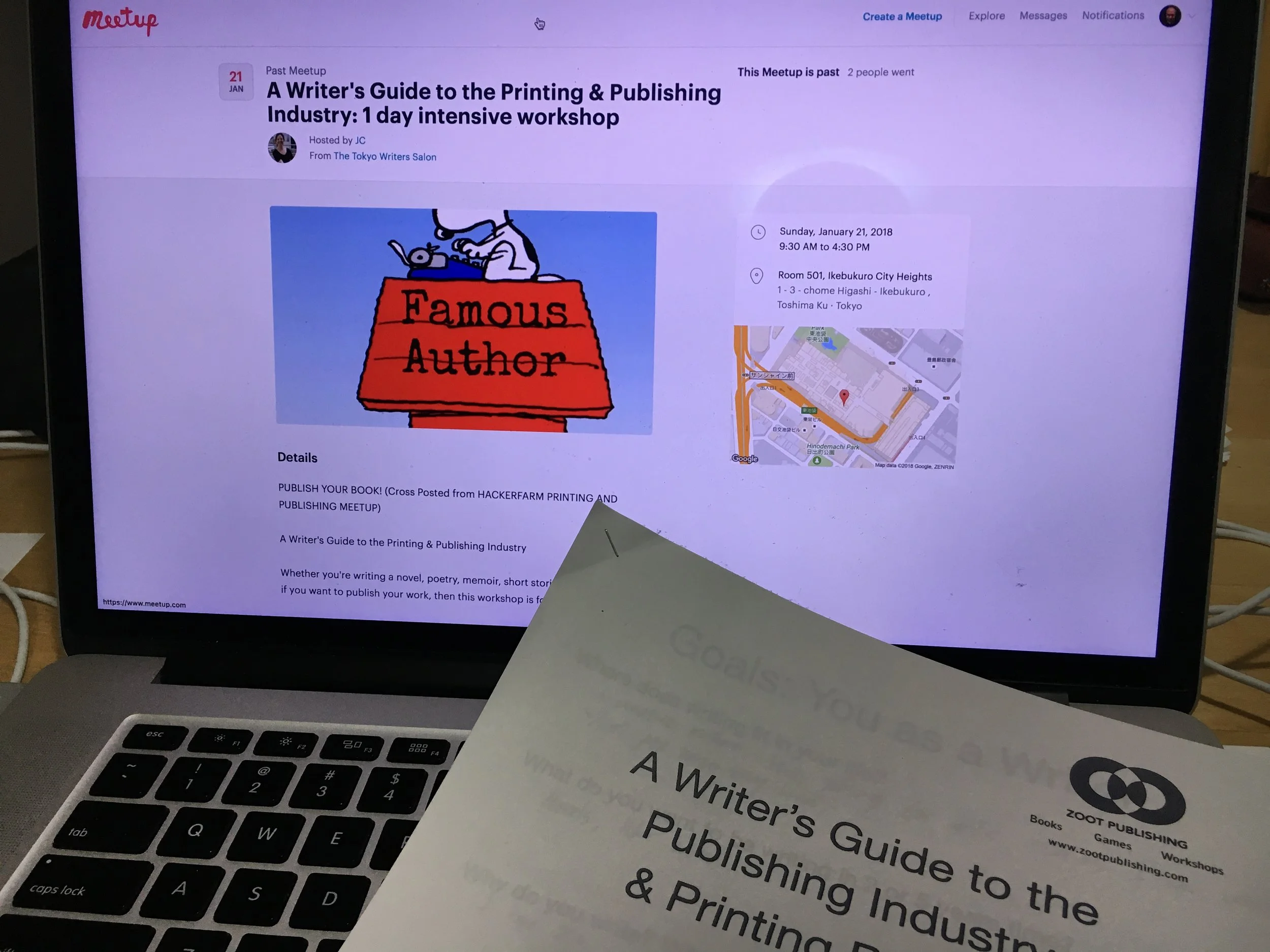
The immediate alternative, not publishing at all and just writing because I enjoy it, I finally rejected. That decision came during a seminar I attended in January 2018 by Hackerfarm and Zoot Publishing where I got a very useful introduction to the publishing industry. I had always wished I could find a traditional publisher, because then I could just write and let the publisher take care of selling the books. What I learned at the seminar, though, and what many online have also said, is that these days the traditional publishing houses expect authors to do much of their own marketing. So I thought if the publisher isn’t going to handle all the marketing of my book, then why not just do it myself? After all, on a shoestring budget, what do I have to lose?
I began to think beyond the thinnest shoestring when I contemplated creating a website. The two platforms most often recommended are WordPress and Squarespace. My impression is that a WordPress website can be put together less expensively, but the platform can be more difficult to work with for anything beyond a basic blog. I do not know whether I will actually sell anything from my website, but I like Squarespace’s e-commerce capabilities. I also want the ability to do pop-ups, etc. That requires Squarespace's Business plan, cheaper if you buy it by the year, $216. I certainly don’t have unlimited friends, but a few dollars of royalties each from those who might actually buy could cover the cost of the website for a year.
Then I began looking at more self-publishing advice on the Internet. For example, one especially helpful site is The Creative Penn. This site and many others say how important the cover art is for a book, either physical or digital. My first novel, Under Shōko’s Bed, is about an artist and I think one of the things sketched in pastels in the novel would be a great starting point for a cover. Unfortunately, inexpensive covers are based on stock images, and the sketch by my artist protagonist is nothing like a stock image. That means finding a real illustrator, and that will likely cost much more. And with that decision, my friends are no longer going to cover my costs. Either the book has to find other readers, or I have to spend money just for the joy of knowing I made something as well as I could.
If I am going to sell some hundreds of books, though, then what about editing? That is the other thing that Joanna Penn and others say is well worth the investment. Writers are always gushing over their editors. Do I need a professional edit of my novel? I have a Ph.D. from a great university, but it’s in a business field, not language or literature, so while my editing skills should be above average, I don’t know that I am good enough all by myself for a major novel. My wife, who has also served as an editor on Under Shōko’s Bed, has a masters degree, but it’s in engineering. She even works part-time as an editor! But she does native English edits of papers written by non-native English speakers. (Honest to goodness, what she does with these manuscripts is nothing short of amazing. Her ability to understand and fix their broken English, making it concise and clear—it’s like watching a psychic channel the author’s innermost thoughts.) But that is academic writing, not novels. And in fiction, I am a rookie author. I thought the first draft of Under Shōko’s Bed was great. It wasn’t. I think the seventh draft, though, is quite good. But having an editor go through my work, someone with experience editing best-sellers, would be both a wonderful learning experience and could possibly turn my very good novel into one with real literary quality. But whether it can be raised to that level or not, trying is going to cost between $1000 and $2000 (for a 110,000-word novel, freelance editor found on Reedsy, but I will talk about that more in a future post). From what I have seen online, that is not at the high end in terms of expense.
On top of that, I would like to create an audio book of the novel. I would like to do the reading myself, since I have been told I have a voice that would be good for that. But that’s not the kind of recording you can do for free with GarageBand on your Mac. It requires much higher quality sound with actual recording studio acoustics. I don’t know the exact price yet, but with the number of hours required, that’s going to cost hundreds, even with extreme pricing competition between recording studios, since Tokyo has a glut.
An ebook, a physical book for a print-on-demand service, and an audio book will require three separate ISBN codes. ISBNs are much cheaper if you buy them in bulk. For example, one costs $125, while 1000 cost only $1000. I can buy 100 for $5.75 a piece. Since Under Shōko’s Bed is not my only novel, I might as well save money in the long run and buy 100. Then there is copyright registration, which looks like it will cost only $55.
I have not even thought seriously enough at this point to guess what marketing costs will be.
Total all of this up, and if I manage to sell a book in one of the three formats (digital, paper, audio) to 100 friends and family, I will lose so much money that it will be akin to giving each of them the book with a $50 bill tucked inside as a bookmark. I am well on my way to becoming a cautionary tale!
At the same time, though, I will have produced something of which I am proud. And my second novel will benefit from the learning of my first, and some of the costs are fixed, so that the second novel’s costs might be a wee bit lower (although the biggest costs are editing, cover art, and audio studio time, which are not at all fixed). I hope that the biggest difference between the unconventional love story Under Shōko’s Bed and the thriller Neyuki, my second novel, is that some of those who read Under Shōko’s Bed will like it enough to buy Neyuki. If I can keep producing the stories that flow out of my slightly twisted mind, and keep readers entertained with them, I may eventually have a large enough following that my children won’t have to decide whether they are willing to pump money into the website, etc. to keep things going. Royalties that cover my expenses, that’s my long-term goal. And if someday years from now I finally break even on all the cumulative expenses, then I can sit back with a smile on my face and know that I still could have done better financially by spending my retirement working at McDonald’s.
In the end, it’s for the writing, not the sales. It’s for the pride in a story well told, not the profit.
Although a little external validation would feel nice; better than an Egg McMuffin, certainly.