Editing M. Harmon Wilkinson Editing M. Harmon Wilkinson

Approaching a major rewrite II

The key was to just start writing, and an idea for an engaging subplot presented itself. 

This is a short blog post to update the major rewrite of Novel4, which is coming along faster than I had hoped.  The key was to just start writing, and an idea for an engaging subplot presented itself.  I was able to excise the character I wrote about last time with the untoward relationship and replace that subplot with the new one.  In fact, I wrote so much on the new subplot that now the novel is far too long.

I had one final vexing problem:  how to make the last major plot twist that was driven by the excised character in the first draft.  I finally realized that I could create something very similar if I rewrote that character minus the objectionable relationship.  Now that character will play a much smaller role.  Whether the idea actually works remains to be seen.  I have not yet done that rewriting but hope to finish it this month.

It is so exciting, though, to see the second draft of the novel coming together. It had been so daunting earlier in the rewrite.  There will still be a huge amount of work to do after this second draft is finished.  I’ll have to cut tens of thousands of words.  Even harder than slashing so much will be raising the quality of the language.  I trust, however, that time and effort—and a healthy dose of imagination—will make those jobs as fruitful (and enjoyable) as this current task.

Read More
Editing M. Harmon Wilkinson Editing M. Harmon Wilkinson

Approaching a major rewrite

I am rewriting my fourth novel, a major reworking that is unlike any editing I have done before. At first challenged, I am coming to love the process.

My first two novels, Under Shōko’s Bed and Neyuki, are waiting on editor feedback.  This has left me free to either work on one of my other novels or jump into something fresh.  I have been doing so much editing that I want to break out and start a new piece, but I also feel the weight of those other novels, so that remains my focus for now.  There is good content in each of the three, but they need major reworking.  I had been having a terrible time trying to lose myself in the work, and I finally realized it was because I had never done that sort of thing.  I have done big work on the first two novels, but I never had to reform them completely.  

For the first of the novels to reform, I chose a still untitled work that for now I simply call “Novel4.”  I wrote it a year ago as I was waiting for my editor to get to Under Shōko’s Bed.  In the time since then, two editors have been through Shōko, and the learning from those edits colors my reading of Novel4.  So many things I did not recognize as problems a year ago now jump out at me.  I have also grown through Tokyo Writers Workshop.  There are so many viewpoints and what I learn each month from the group is all fresh in my mind, especially recognition of my weaknesses.  Also, I am reading more.  I have mentioned before that reading has never been easy for me.  I find as I read now, though, I notice more what the writer is doing.  I see writers taking chances and doing things differently than I would have expected.  All this teaches me as well.

The big problem with Novel4 is that it needs to lose an entire character, even though she was the driver of major twists in the plot.  Re-plotting the novel was being a chore, when writing is supposed to be fun.  So I decided to stop pushing myself to have everything decided in advance.  I love the wonder of the story coming to me as I go.  Granted, it can be dangerous.  You can write yourself into a corner—or do what I did and create a cringeworthy relationship between two characters that would make the reader abandon the novel.  I am on more solid ground now, though, than I was a year ago.  So I have an idea of where the novel is going, I have last year’s content as a framework, and I have my imagination as I write new relationships into the novel.  It gets more interesting and exciting by the day!  I just wish I had the time to work through it faster.

Read More
Editing M. Harmon Wilkinson Editing M. Harmon Wilkinson

Website: 1st anniversary

It’s the first anniversary of the website and the blog! It has been a productive year.

I opened this website and made my first blog post one year ago today. I have spent most of my “writing” time in the last year editing my first two novels, Under Shōko’s Bed and Neyuki. I had been working on both novels for a long time and thought they were in good shape. I never imagined it would be such a long and difficult process. They are much better novels today than they were a year ago. In fact, my editor persuaded me to try traditional publishing for Under Shōko’s Bed rather than self-publishing as I had planned.  The long editing process, though, has meant I have not sent it out yet. That should happen this month.

I did not spend all of my time editing, however. I wrote first drafts of two more novels. They both need major rewriting before I show them to anyone. I enjoyed the writing, but now that I see how involved editing is, I will approach future first drafts with much more deliberation. The project has to be something I am willing to sink years into, not just weeks or months. That is a sobering commitment.

The first year of the website also saw twenty-two blog posts. I slowed down late in the year as editing consumed more time. I didn’t feel I needed to document the editing with more posts.  The slowdown, however, may also have been because of my obsessive nature and how it impacts my work. It was difficult to concentrate on blog post topics when my mind was swimming in tightening a novel.

I hope the next year is even more productive, and I look forward to entering the publishing part of the authorship experience. I also hope to spend less time editing and more time reading.

Read More
Writing process, Editing M. Harmon Wilkinson Writing process, Editing M. Harmon Wilkinson

Editing: Neyuki

I am both pleased and disturbed by how little of Neyuki’s content I sacrificed in whittling down the word count so significantly.  It implies my original writing was wordy and repetitive.

In my blog post a month ago, I mentioned that I have been editing Neyuki, getting it ready to go to my editor in March.  My goal was to cut it by 20 percent from 145,000 words.  I think I am as close as I will come to that goal at 120,300 words (17 percent cut).

I am both pleased and disturbed by how little of Neyuki’s content I sacrificed in whittling down the word count so significantly.  I hope it suggests my wife and I may be imaginative, expressive editors, but it also implies my original writing was wordy and repetitive.  I am learning, though, and hope future writing will be both more efficient and more moving.

As with all but the broadest editing of Under Shōko’s Bed, I found it easier to work off of a printed version of the novel.  It allows more deliberate, thoughtful changes to the text.  One place I departed from that is in using ProWritingAid, a digital editor.  Those changes, however, were smaller adjustments in wording.  I plan to read through the novel (yet again) to make sure those edits do not affect the flow of the text, since most of the ProWritingAid alterations occurred without an extensive review of the surrounding text.

The edit has been time consuming as both my wife and I worked through the entire text twice (some sections much more) to save 25,000 words.  We’ve been bereft of free time for the last two months.  With this edit nearing completion, I am considering what comes next.  First is another pass through Under Shōko’s Bed, since I am getting feedback from a second editor, Sadie Rittman (the daughter of the editor who worked on it last summer).  I also suspect a window of opportunity will close soon for my fourth novel as a subject-matter expert will leave Japan this summer and easy access to his wealth of knowledge will disappear.  The more daunting question with that novel is what bigger, deeper meaning I will offer to readers than the arcs of the various relationships, both loving and unfaithful.

It will be a momentous winter and spring!  I hope I will be efficient too, since I have my third and fifth novels to whip into shape, and I still hope to create new content at the same time I am editing the old.

Read More
Editing M. Harmon Wilkinson Editing M. Harmon Wilkinson

Writing software: ProWritingAid

Human editors are a must, but an algorithmic editing tool can help you improve your writing before you send it to a real editor.

A couple of weeks ago I savaged AutoCrit.  I was probably too harsh.  It is a useful tool, despite the limitations I found.  I still believe, though, that $30/month is too hefty a price for how much good it would do me.  What if you could have the usefulness of an algorithmic editing tool, plus Scrivener compatibility, for $60/year (or less with a coupon code)?  That sounds better to me, and that’s what I found in ProWritingAid.  I have been using it for the last week, and it’s been worthwhile.  This morning I bought a lifetime membership, which costs the same as three-and-a-half years at the yearly rate.  I may not use it that long if artificial intelligence takes major leaps forward and ProWritingAid ends up lagging behind other tools, but it has impressed me enough that I am willing to take a chance.

ProWritingAid has over twenty different reports.  I am finding the most useful to be spelling and grammar (it has caught a handful of errors that I hadn’t noticed on multiple read-throughs) checks of overused words, sentence structure and length, and style suggestions such as cutting adverbs and hidden verbs.  One of my biggest challenges is to make my writing more concise.  The myriad things ProWritingAid can flag help me reassess my writing and look for shorter, better ways to say the same thing.  It doesn’t fix my writing; it spurs me to do it.

One report that I am a bit suspicious of is the “Sticky Sentences” report.  It claims that writing that is too full of the 200 most common words is like glue; it slows the reader.  I have, however, tried this out to flag sentences, and have actually found it to be helpful as it pushes me to use more active, meaningful, or precise vocabulary.

Of course, ProWritingAid is still an algorithmic tool, and as such, it is woefully dumb.  Almost all of the grammar issues it highlights are not errors at all.  In that sense, my disappointment in AutoCrit applies equally to ProWritingAid.  It takes patience to sift through all of the non-mistakes in search of the few actual errors in the text.  At least ProWritingAid is not charging me much for all the trouble.  

In the end, ProWritingAid has one more significant advantage: it can open and save files in Scrivener format.  That convenience makes all the difference.

I would never trust the scores that ProWritingAid gives as actual measures of the quality of my writing.  Writing is art, and computers will never understand how words can move you.  Human editors are a must.  An algorithmic editing tool, however, can help you improve your writing before you send it to a real editor.

Read More
Editing M. Harmon Wilkinson Editing M. Harmon Wilkinson

Writing software: AutoCrit

Don’t spend $30/month for AutoCrit.  Spend $1 instead and try it out.  It will make you all the more thankful that there are talented human beings who are actually willing to edit another person’s work.  
National Novel Writing Month (NaNoWriMo) concluded a month and a half ago and I have not written a blog post since.  I guess that level of daily output burnt me out.  I finished the month with 75,100 words.  Added to the 20,000 I had before NaNoWriMo started, the novel is over 95,000 words. It needs a major edit, including some fundamental changes.  All of that will come later, though.  I am letting it sit for now while I work on other things.  Chief among those is editing Neyuki, trying to cut it by 20 percent before it goes to my editor in early March.  In December I cut it from 145,000 words to 134,500.  That leaves me 18,500 words shy of my goal.  This may simply be a goal I don’t reach, although I am trying hard to cut at least another 10,000 words.

As I looked at the various sponsors of NaNoWriMo, one that intrigued me was AutoCrit.  They offer an online editing program on a subscription basis ($30/month for the Professional plan, $80/month for the Elite plan).  This week I signed up, since they offer a two-week trial for just $1.  Knowing how lame online translators are, I was skeptical that an online, algorithm-based editor could be worth the money that AutoCrit is charging.  That skepticism was well founded.  While AutoCrit’s algorithms seem to be surprisingly sophisticated, they cannot begin to match the usefulness of a human editor.  I think that might be true for even a poor human editor—and I have good ones.  I have written about them before.  The first one, my wife, is quite accomplished and does editing part time in addition to her day job as a teacher.  The second, Fran Lebowitz, whom I found on Reedsy, is a professional with truly enviable client comments.  (One of those is from me.)  Compared to either of them, AutoCrit fails miserably.

I am not saying that AutoCrit is not useful.  It told me that I start too many sentences with “and” and “but,” which is probably true.  It also says that I overuse the words “just” and “even.”  But it also told me about useless things, such as my use of clichés.  For example, it said I use “on the table” too much.  How else do you say, “She put her purse on the table”?  That’s where algorithms fail.  Language is far too complex for today’s algorithms to effectively understand or classify.  Where AutoCrit fails, though, is not just its identification of writing problems using too-simple algorithms, but then using those results to give writing an overall score.  Under Shōko’s Bed scored 74.9.  Being a professor, I can’t help but see that in letter grade terms, and I refuse to believe that my novel rates nothing more than a C.  AutoCrit needs to give up on the meta-analysis and just stick to the stuff where it’s actually useful, like counting sentences that start with “and” and “but.”  Unfortunately, the simple stuff isn’t worth $30/month.

In conclusion, don’t spend $30/month for AutoCrit.  Spend $1 instead and try it out.  Do it because it will make you all the more thankful that there are talented human beings in this world who are actually willing to edit another person’s work.  Then find one of those people.  You won’t be sorry.

Read More
Writing process, Editing M. Harmon Wilkinson Writing process, Editing M. Harmon Wilkinson

(Im)patience

Waiting—and editing—but still, waiting.
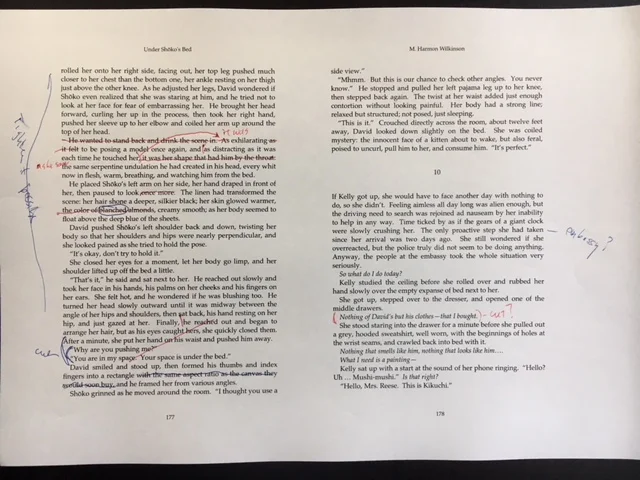
I am still editing Under Shōko’s Bed.  The marks this time through are much fewer, though.  Of course, I must eventually stop—and I want to; I have other projects.  But I want this novel to be as good as I have in me.  So four other people are reading it now.  I gave out red pens along with the novel.  I will have their feedback in a few weeks.  I don’t know whether to hope for a lot of red ink.

In the meantime, I will finish my own edit, then read it through yet again, but more quickly, trying to judge the flow of the story and whether it drags.  If I’m still waiting at that point, I will work through the text slowly—hopefully for the final time—looking for more of the problems William Strunk proscribes in The Elements of Style.  One by one I am getting them into my head (appropriately updated for changes in American English in the last hundred years.)  I wish I had a punctuation expert.  I know the basic rules.  I am into gray areas now that punctuation pundits on the Internet never mention.  My wife tells me that in those situations I can simply decide, so I do.  And I am careful to keep the punctuation all internally consistent.  Still, I’d be more comfortable if there were rules.

As others read, I have to keep working.  I don’t have the patience to simply wait.  When I cut through all of this impatience, though, I am staring at the same difficult decision I have been facing all along: whether to self-publish.  I had decided to do that, but my editor told me the story is good enough for a publishing house.  Now I’m all up in the air again.  If I self-publish, it’s time to be finding a book cover designer.  If I go with a publishing house, I imagine they will handle that.  But how long could it take to find a publisher?

More than anything, I hate the indecision.  I am impatient to know what will happen.  But it’s a journey, and I choose the path.  So I will contact my editor again and get some advice on publishers.  But when I do that, I would like to send an updated manuscript, and that means waiting for my readers to give me feedback.

Waiting—and editing—but still, waiting.

Read More
Writing process, Editing M. Harmon Wilkinson Writing process, Editing M. Harmon Wilkinson

Editing: Under Shōko's Bed II

Editing is a painful process. It hurts to erase words that feel emotionally invested. But then you read it again, and the benefit shows. Under Shōko’s Bed is nearly complete.

I wrote two weeks ago about editing Under Shōko’s Bed.  It has taken only a few weeks, but has been a very difficult process as I cut and cut and cut some more.  The 7th draft was 107,700 words.  The latest is 98,200.

For cuts this difficult, I found it helped to print out the chapters and make the edits with a pen rather than working on the computer.  The edits felt less final that way; each was just a “maybe.”  With a whole chapter’s worth of edits, I went into the text in Scrivener, thought through the changes again, and made the ones that I still felt were good.  In my last post, I mentioned Stephen King’s counsel that you have to be willing to “kill your darlings,” and this edit was exactly that.  It hurt.  And using a pen at first decreased the pain enough that I could make the cuts that much deeper.

Once I was done with all of the changes from my editor, Fran Lebowitz, (draft 8.0) I focused on shortening and worked with my live-in editor, Wallis.  I have mentioned her editing skill before (The Decision to Self-Publish), but I saw it on full display once again.  She is much better than I am at judging pacing.  Her help was invaluable in making tech and art sections less didactic.  She also has a gift for slashing unnecessary words.  She used a blue pen, I used a red one, and the pages got pretty colorful.

Once Wallis was done, I went through William Strunk Jr.’s The Elements of Style and followed most of his prescriptions.  I deleted scores of instances of “very.”  I also deleted hundreds of adverbs.  “Alright” became “all right.”  I fixed “compared to” and “compared with,” “can” and “may,” and “like” and “as.”  Then I went through the text to turn ellipses and em-dashes into commas, etc.  That completed draft 8.1.

There are still a few things I need to check that will require a full read through.  I doubt that I have split infinitives, but I should be sure.  I need to examine my use of participles for verbal nouns.  I need to read to see that participial phrases at the beginning of sentences refer to the grammatical subjects (Strunk’s rule 7), and that I have expressed coordinate ideas in similar form (Strunk’s rule 15) and kept related words together (Strunk’s rule 16), among other rules.  That will be draft 8.2, but while that is in process, a few friends will read draft 8.1 and give feedback.  

The editing is nearly done!

Read More
Writing process, Editing M. Harmon Wilkinson Writing process, Editing M. Harmon Wilkinson

Editing: Under Shōko's Bed

If I want Under Shōko’s Bed to touch people, they have to read it, and my editor reinforced that the plot has to move, the tension has to increase and the pace has to quicken as the novel approaches its climax, and then it needs to end promptly.

I am in the process of a new (8th) draft of Under Shōko’s Bed, making the changes suggested by my editor, Fran Lebowitz.  I found her through reedsy.com, a very useful platform.  She has edited best-sellers, and before that spent years as a literary agent.  The edit was a long time coming; I first contacted Fran in March, but she was booked up into July, so I waited four months.  I waited because her testimonials were superlative.  And it was a productive wait; I wrote the first draft of a whole new novel.

This is my first professional edit, so I was not sure what to expect.  Fran’s editing process is a little old school, but it has worked well.  I sent her a PDF manuscript of the novel.  She printed it out (400 pages) and then sat down and worked through it, pen in hand.  When she was finished, she scanned it and sent me a PDF of the manuscript with its handwritten notes. 

I had imagined Fran telling me that my punctuation needed work, too many ellipses and em dashes, for example, and that I too often stray into passive sentence constructions.  I thought every page would likely be marked up with myriad changes large and small.  What I really feared, though, was that Fran would tell me, “Some people were never meant to write. Count yourself one of them.”  Instead, she sent me a message halfway through the edit: “Hi, your writing is sublime!  I’m making so few notes that my conscience is screaming at me. … I am so impressed and must say you do seem ready for prime time, no kidding.”  She believes in my writing enough that she is willing to make introductions to agent and publisher contacts!

When Fran’s edit was finished, and I saw her notes, I found that most of my pages had no marks at all.  It seems that my punctuation and grammar are actually quite good.  And Fran did not try to change my voice.  She did, though, have a few pointed criticisms about pacing, the treatment of the subject of depression, and an overabundance of tech and art detail.  So now I am fixing things.  I have cut the first and last chapters by 30 and 60 percent, respectively.  That is still less than the 50 and 70-90 percent that Fran recommended.  I have cut out a few scenes entirely.  I have cut technical details.  I am just starting the process of removing enough of the art content that the reader does not feel she is being subjected to an “art class.”  The cuts so far total 7400 words, 7 percent of the novel.  It’s hard, but I keep reminding myself of Stephen King’s words in On Writing: A Memoir of the Craft, “Kill your darlings, kill your darlings, even when it breaks your egocentric little scribbler’s heart, kill your darlings.”

With each cut, I can see the novel getting tighter.  I loved the details, but the reader would not have.  In the end, if I want Under Shōko’s Bed to touch people, they have to read it, and Fran reinforced that the plot has to move, the tension has to increase and the pace has to quicken as the novel approaches its climax, and then it needs to end promptly.

There is a lot more work to do.  I’ll post again in two weeks to report how the rewrite is progressing.

Read More