Writing community M. Harmon Wilkinson Writing community M. Harmon Wilkinson

Writing buddies

Perhaps what’s most important in a writing buddy is having someone who shares the same dream.

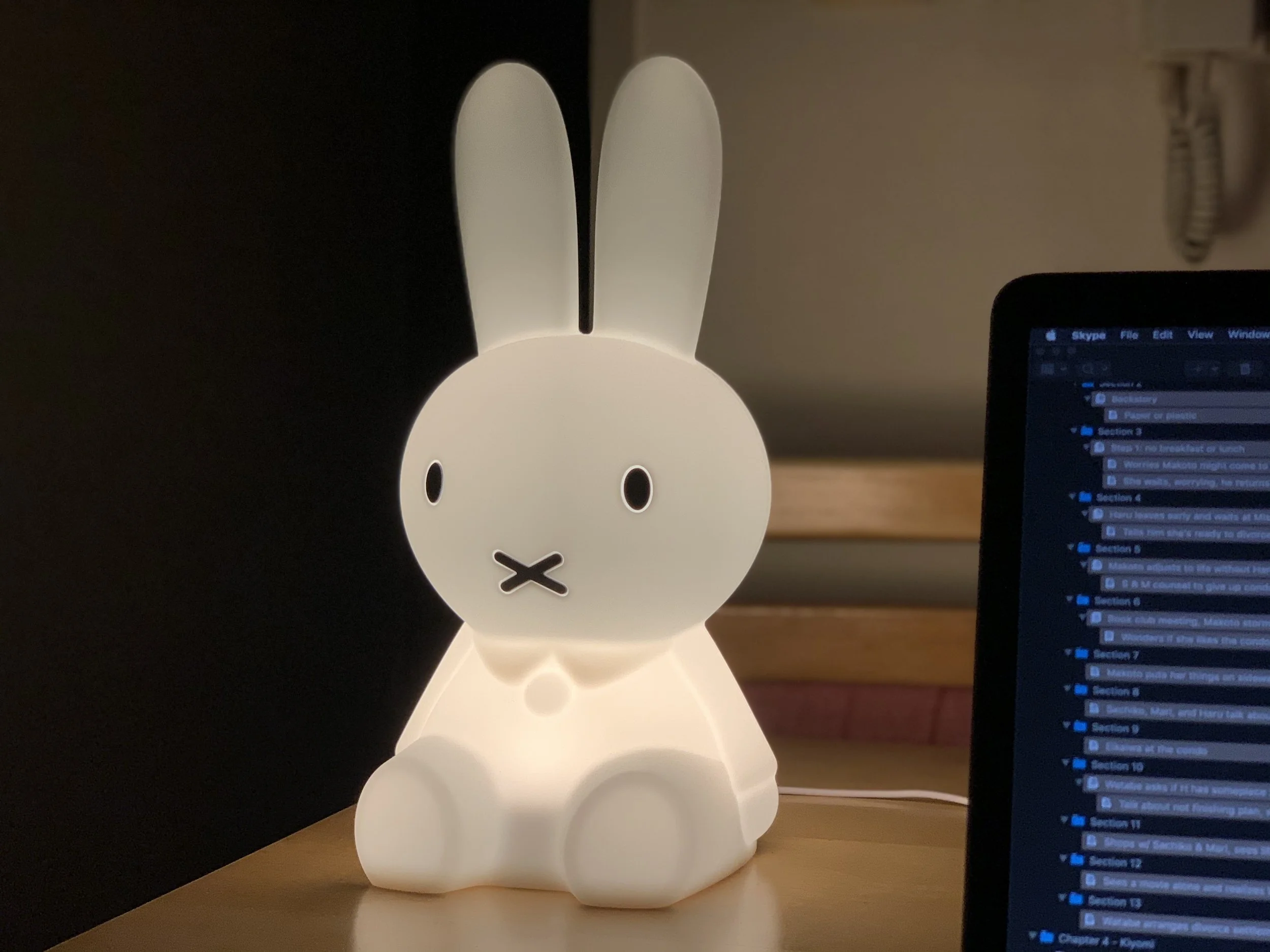
Do you have a writing buddy? Predawn is my favorite time to write. I enjoy the quiet of our small Tokyo apartment in those hours before the street outside begins to bustle. With my Mac set on “dark mode,” I leave most of the lights off. I do, however, turn Miffy on. We got Miffy as a nightlight for our toddler granddaughter, only to discover she already had one she liked. So now Miffy, always stoic, but with a glow so gentle and warm, serves as my early morning writing buddy.

Of course, it helps to have people who can talk back when you want to explore an idea. For that, my first and closest writing buddy is my wife. She is not writing something of her own, so in the strictest sense she is not a writing buddy. (Miffy doesn’t write much either, though she makes the morning more pleasant.) My wife is so involved in everything I write that it’s unusual for me to compose something without showing it to her. I cannot write first drafts strictly for myself, as Stephen King suggests. His wife sees second drafts he has cleaned up. My wife sees everything. She stays encouraging, though, telling me only that something “needs polishing,” not that it’s awful. I like to think it’s because I don’t do awful, but I trust my wife’s charity more than my talent. And when something works especially well, she tells me that too. Those are proud moments, for her judgment stands the test of time better than my own.

As far as writing buddies who do write, I have only one, my friend Jacinta. She’s an Australian who lives in Japan. I met her at a workshop she taught on printing and publishing in January 2018. It was there I began thinking about self-publishing my first novel. (My editor has since convinced me to try going the traditional publishing route, although it is slow enough that I expect I will lose patience before much longer.) In May 2018, I attended a weekend writing retreat Jacinta hosted. There, we agreed to exchange daily writing shout outs to keep each other motivated and writing every day for a month, for it is constancy to purpose that gets a novel written, not momentary genius. At the end of the month, we decided to do it again. That was a year and a half ago, and most days since then we’ve messaged each other with encouragement. She is out of the country now, so rather than another physical writing retreat, we have a three-hour virtual retreat early in the morning on the first Sunday of each month. 

It’s interesting that Jacinta and I share little of what we write. Instead, we share our process and an optimism that if we keep writing, the process will create something worth publishing, for neither of us is writing purely for herself or himself. Maybe that’s what’s most important in a writing buddy, someone who shares the same dream. Jacinta does. My wife does too. And I trust Miffy does. She won’t say.

Read More
Writing life M. Harmon Wilkinson Writing life M. Harmon Wilkinson

Balance

Balance: it’s so much more than an inner ear thing.

I’m writing about balance this week not because I have achieved it, but because I fail at it so miserably. Still, I realize how important it is. In fact, I struggle with it every day. I am just naturally obsessive in my work. It is difficult to get my mind wrapped all the way around a problem, and once it’s there, it’s also hard to tear it away. I can code a computer program for hours, forgetting to move, to eat, to take even a break to stand up and walk around, until I get so tired I can no longer understand the code I have written and tested. Writing is the same way. It winds through my mind like great tree roots, and while the result is not always worth keeping, the oneness with the characters and emotional connection with the story are wonderful to feel. It’s as if the tale is growing and leafing out right before my eyes. It’s no wonder that when it’s time to stop, even if the writing is tortured, it’s so hard to reel my mind back in and then sink it into something else.

Lately I’ve been doing even worse with balance than usual. I don’t know what the difference is. Neither does my psychiatrist. My monthly visits with him rarely take five minutes. I’ve told him things aren’t going very well. He doesn’t know what to change. I suspect he’s just happy I’m not depressed and doesn’t want to adjust anything that could send me into a tailspin. Above all, do no harm, right?

I also worry about the time invested in my writing not only by me, but by my wife, who is my first reader, first editor, and first critic. Reading and editing my work chews up too many hours of her weeks. She doesn’t complain—she’s a giver in every respect—but I don’t give enough in return. As I quoted Stephen King in the picture that goes with this post, “Life isn’t a support system for art. It’s the other way around.” My art makes my life richer, but does it enrich us enough? When I ponder that question, my response not being an obvious yes troubles me.

So I will keep questioning, keep trying to keep my balance, stand up straight, and not fall over as I feel my way along, keep holding on to the iron rod in faith that I’ll get stronger along the way—and keep an eye out for some great tales to tell.

Read More
Writing process M. Harmon Wilkinson Writing process M. Harmon Wilkinson

Routine

My goal is 1000 words per day, but editing tears me away from it.

I haven’t been writing anything new lately.  I’ve been engaged with writing; it’s just been editing instead of generating a new story.  I’m missing the imagination that goes with writing something new.

It would be ideal if I could spend part of my time writing and part editing.  The problem is that I have a regular job, so my overall writing time is less than I would like.  An even bigger problem, though, is that I tend to work obsessively.  I have to totally wrap my mind around something in order to be most productive, and once my thoughts are completely focused, it is extremely difficult to transition to anything else.  So I work in spurts, first one thing and then another.  It’s hard enough to go back and forth between work and writing, let alone to switch between writing a new story and editing an already written one.

So, given that difficulty making transitions, how do I keep motivated when I have to wait, or when I’m writing a new story and the writing gets difficult, the path ahead too dim to see?  As simple as it sounds, one thing that keeps me moving is not ruining my unbroken streak of writing (or editing)—currently 175 days.  Even stronger, though, is that I really enjoy my writing time.  I don’t feel like a day is complete if it doesn’t include at least a little fiction.

When I’m writing a new story, my daily goal is 1000 words, and I set myself a minimum of 200.  Sometimes I barely reach the minimum, and sometimes I get thousands.  I try to keep perspective by using Stephen King’s daily word count as a yardstick: 2000 words.  He is an unbelievably prolific writer.  I find that if I can get a solid three to five hours to write, I can achieve his daily goal, but I don’t generally have that much time.   So I decided that if I could be half as prolific as King (hence my 1000-word goal), I should count myself an unqualified success.  He does his editing in the afternoon.  Mine, on the other hand, tends to take the place of producing new stories, so I will likely not be half as prolific as King.  I suppose I should be pleased to have a quarter of his output.  (And I would be ecstatic with even a smidgen of a percent of his sales.)

King and other authors speak of the importance of a writing routine.  They write at the same time, in the same place, each day.  I generally get up very early and begin writing once I am fully awake, which happens by four or five a.m.  I write at the kitchen table.  Well, it used to be a kitchen table.  Now it’s covered with computers and other random things (not all mine).  We take our meals family reunion style sitting on the sofa and watching American politicians argue the country into … no, no, this isn’t a political blog.  The most difficult part about writing at the table is that it’s in the middle of the house.  Writing would be better in a little room with a door I could close.  This is Japan, though, and the apartment is too small for that.  It’s another reason to get up early: I get hours undisturbed.

So if you are ever wondering what it looked like for me to write one of these novels, just imagine me in my pajamas (surgical scrubs), sitting at a wee kitchen table, typing away obsessively on a 15” MacBook Pro.  Average 1000 words per day for a hundred and some days and it turns into a whole novel.  And then comes the editing.

Read More
Writing process, Books on writing M. Harmon Wilkinson Writing process, Books on writing M. Harmon Wilkinson

Books on writing: Stephen King

I recently reread one of the best books for authors, Stephen King’s On Writing: A Memoir of the Craft, which offers marvelous advice and is exceptionally well written. 

I recently reread one of the best books for authors, Stephen King’s On Writing: A Memoir of the Craft.  It’s not that Stephen King is my favorite author, it’s just a marvelous book and exceptionally well written.  King not only gives great advice, but tells the story of how his writing developed, all in his own very direct style, the story being the driving force.

Those who’ve read Stephen King, and many who haven’t, have opinions of his writing ranging from genius to hack.  I think he’s a great story teller.  Others obviously agree: over seventy of his novels and other stories have been turned into films or TV shows.  Some would say that this mass appeal itself is an indicator of low quality, but I think it is stunning that King has been able to produce so much work, so consistently, for so many years, with such popularity.  If I can tell my stories half as well, I’ll be lucky.

Let me focus on just a few bits of advice from On Writing that were the strongest take-aways for me this time.

Read a lot.  Write a lot.  This one piece of advice is at the same time the most inspiring and damning thing for my writing, for I do not read enough.  Reading is hard, my mind wanders so constantly, and I have to force myself to do it.  King might say that someone like me should not even try to write, but I soldier on with both the reading and the writing.  The writing is good for me.  The reading may be even better.  And there are stories that eventually grab me and take me away.  It’s worth the work to get there. 

Be honest.  This advice is so broad and so monumental that it looms over all I write.  Part of it is making the stories as alive on paper as they are in my head.  Part of it is imagining characters and situations that are real enough that a reader can empathize with someone who is a figment of my imagination.  Both of these parts are impossible ideals.  The joy is in approaching them.

Write the first draft with the door closed, the second with the door open.  King advises against getting feedback before the first draft is complete.  I am too needy, though.  I ask my wife to read one thing or another almost every day.  But I was impressed with this dictum as I read it this time and I am trying write the first draft without immediate feedback and just get the story out.  I think there’s confidence that goes with this that makes me a better writer, that makes my writing more honest.

Adverbs are not your friends.  It’s a simple idea, but it’s hard to write without them.  Most of it happens for me like King says it happens for him, at the editing stage.  I read through the text and look for adverbs to cut.  It’s hard to do.  When it’s finished, though, I find that I’ve lost no essential meaning.  The story reads better.  It’s almost like magic.

Write every day.  King writes 2000 words a day.  With that level of output, he can write 180,000 words in three months, the maximum time he suggests for getting a first draft of a story out.  Longer than that, King says, and it can grow stale and the writer can lose motivation.  I have a job and don’t have time to produce 2000 words a day, so I shoot for 1000.  That takes two to three hours.  It’s a major commitment of time; big enough to be scary, in fact, as I wonder sometimes whether what I am writing is worth all the time.  I enjoy those hours, though.  The stories mean something to me.  I think that’s part of the honesty that King values so highly.  I do have a question, though.  How does editing fit into King’s 2000 words-a-day work schedule?  Is it extra, or is editing 2000 words just as much work as the original writing?  I suspect it’s the latter.  At least, it seems to be that way for me.

Let the first draft sit for at least six weeks before you start on a second draft.  I have done this before, and I have come back to it with new eyes and new appreciation for what works in the story and what doesn’t.  It takes time to get that kind of separation.  Besides, in those weeks of waiting, there are always more stories.

I’m sure that the next time I read On Writing—and I will read it again—different things will stand out for me.  Classics are good that way.

Read More