Obsession
Writing obsessively over the last few months, things have fallen by the wayside, including this blog.
Writing obsessively over the last few months, things have fallen by the wayside, including this blog. I haven’t had anyone message me and ask, “Hey, what’s up with that blog?” Do people do that? Maybe not.
The writing obsession is something I’ve mentioned before. Stories get ahold of me and it’s hard to do anything else until I’ve got them out of my head. I think the characters get to be friends, although I don’t know that’s entirely healthy. I know it makes them harder to do away with. That turned into a problem with the time travel series, as I ended up with too many characters. It’s one of the problems I have to deal with as I rewrite and edit. But loving the story is a marvelous thing. I don’t know how anyone could write something they didn’t love.
Obsession can be a useful thing. It’s a great way to get a whole lot of work done on a project. It’s when you have more than one project that it’s a problem. If only I had a way to change obsessions. Of course, if you can switch, then we don’t call it obsession anymore. We have nicer words, like attention or concentration or focus. I imagine focus having all the advantages of obsession with none of the disadvantages. Too bad that’s not the way my head seems to work.
A hermit's life revisited
During the last year, hiding out from COVID-19, I had more time to write. How will I handle things after I’m vaccinated?
During the last year I have hidden out from COVID-19 and got settled into a hermit’s life, as I wrote about last August. It gave me more time to write. But now there are vaccines and some places are seeing the light at the end of the tunnel. (Although India has taken a horrible turn.) Demand for COVID-19 vaccinations in America has peaked and is falling—to the point in that locations are taking walk-ins. Japan has been creeping along. Vaccinations for the general population have not even begun. I worry my turn won’t come until next winter. So I am being sorely tempted to travel to America, get vaccinated there, and spend a few weeks with my family. I haven’t seen them for over a year. I miss people.
My school started hybrid MBA classes in April. Some students are online and some in the classroom. It’s up to the students how they attend, and it breaks down about fifty-fifty. (The undergrads went from in-person classes in April to totally online when Tokyo entered its current state of emergency.)
The COVID numbers are bad for Japan, but are still relatively light compared to America. I should be staying home as I did last year, but I don’t feel the danger as keenly as I used to. Staying home was affecting my mental health as well. Interestingly, it sort of crept up on me. I didn’t notice myself deteriorating, but it got to where I wasn’t even leaving the house to take a walk most days. I was not depressed. I am sure of that, because I know depression. But I think I would have been except for all the medication I’m on. My outlook, though, has taken a distinct upward and outward turn since I started commuting to school again. It’s interesting how we don’t notice a slow slide until it’s over.
So I am not a total hermit anymore. This is better for me. I’m still not talking to anyone except for my lectures, but I’m out in the crowd, a passive sort of sociality.
More distraction
With all this commotion, I admit I have to push hard to get past the distraction and lose myself in a story.
As summer approaches, my winter/spring distraction continues. As evidence, I wrote the first draft of this post over two months ago. Of course, it is odd that the COVID-19 pandemic has dictated that I stay home and work, when that is what I do most of the time anyway. I feel sympathy for those who are going stir crazy stuck in their homes, but I admit I am feeling none of that. I have stories to write, and I sit at my little table with my little computer and fill my extra hours tapping away on its keyboard oblivious, for a few hours at least, to the world.
My stories do not fill all my time. And the time they don’t fill is so tumultuous and upsetting. It disquiets me to watch the numbers steadily grow: infections, hospitalizations, critical cases, deaths. The restrictions on populations around the world, the unemployment, the economic pain are reaping a horrible toll. It’s hard not to pay attention, in the same way as a gruesome accident tugs at your eyes. Part of this pandemic, of course, seems quite accidental. People bear the blame for other parts, though. Some don’t follow instructions to practice social distancing or self isolation. Some assume they’ll come through it all just fine and don’t consider how those they in turn infect are going to come through it. Perhaps the worst are the few who could have led effective government responses, but were too vacuous or motivated by immediate political gain. They don’t seem to have the sense that there is a longer term problem. They have always gaslighted their way out of problems and assume that will be sufficient here too. It’s not. In democratic countries, such “leaders” can be voted out of office in disgrace. And those who don’t follow through on this weighty, consequential step will be failing us all.
With all this commotion, I admit I have to push hard to get past the distraction and lose myself in a story. But I have been able to push regularly enough to finish another novel and work on edits of a few more. The novel I’ve written isn’t about a pandemic, although a number of its characters die. I joked with a writing buddy that I should get a t-shirt that says, “I kill people. Wanna be next?” At least I am not dispassionate about it. After all, if there is no passion involved in losing characters, what were they doing in the story to begin with? Still, killing off characters at the same time that a pandemic is decimating the real world is sobering.
I wonder how many pandemic stories are being created at this very moment by writers in scores of countries around the world. Their stories will ring with an immediacy they would not have had last year. Even though my writing isn’t immediate like that, I hope I can touch readers.
Distraction
What do you do when you are too distracted to write?
Write anyway.
It has been a late winter of distraction. My primary care physician told me in the middle of February that the pain and bleeding from my kidney could be cancer. He followed that up with pathology supporting his assumption. (It was a middling stage of cancer, but I don’t know if the stages they use in Japan are the same as the stages in America.) He sent me to a urologist. The urologist did an ultrasound two weeks ago and said he didn’t think it was cancer. I just got the results of a CT scan two days ago. A kidney stone is causing the bleeding and pain (which is what I had suspected in the first place). My primary care physician is on my “Grrr” list, but I followed up on his concerns, which was the important thing.
So what do you do with your writing when mortality is close enough to feel its breath on your face (in my worst imagination this happened a lot)? What do you do when you are too distracted to write?
Write anyway.
I have two simple suggestions for that.
First, edit something old.
You can’t stop working, right? If you’re a writer, you write (or revise or at least edit). I sit down to write every day (and I succeed almost every time). I figured I was too distracted to lose myself in an invented world and populate it with characters, but I had novels that needed work, so I edited. It’s calming to sink your mind into a story you know like a comfortable old friend when you want to escape the prospect of death. Mortality also gave me a little kick to get things finished.
It did not help much with the push to publish, though. That’s a lengthy process. Lengthy processes are not foremost priorities when you don’t know how much time you have left. (Yes, it’s sad to admit I was that concerned, but imagination is important for a writer, isn’t it?)
Second, write something new.
This week, I got to where I had nothing I needed to edit. It perplexed me, assuming I could never muster sufficient concentration to write anything new. But tried it anyway. It was an act of faith. (My wife’s constant upbeat attitude also took root.)
And I wrote! I started only a handful of days before I got the “don’t worry about it” diagnosis, but I could write fresh scenes for Novel 7 each day. With a little extra push, I could force my way through the distraction, because the story is strong. I’ve been knocking the idea around for a couple of years, and I think I have worked out enough of the kinks that it’s realizable.
The one thing I did not attempt as I waited for test results was writing more blog posts. If you’re keeping up with the blog, though, don’t assume missing blog posts mean things are going badly. It also happens when I visit family at the holidays or get so wrapped up in writing I can’t tear myself away. The stories matter more to me than the commentary.
Writing buddies
Perhaps what’s most important in a writing buddy is having someone who shares the same dream.
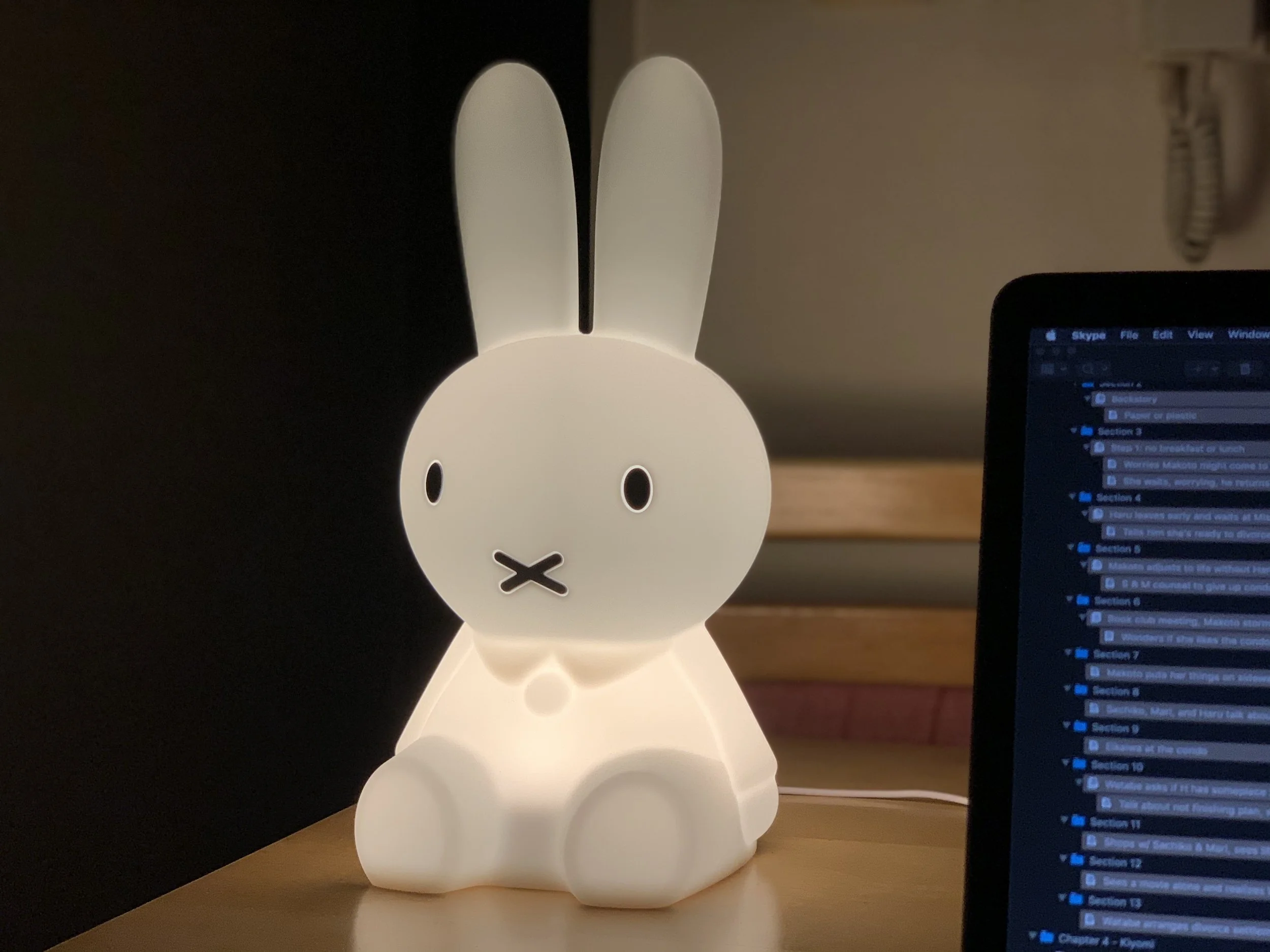
Do you have a writing buddy? Predawn is my favorite time to write. I enjoy the quiet of our small Tokyo apartment in those hours before the street outside begins to bustle. With my Mac set on “dark mode,” I leave most of the lights off. I do, however, turn Miffy on. We got Miffy as a nightlight for our toddler granddaughter, only to discover she already had one she liked. So now Miffy, always stoic, but with a glow so gentle and warm, serves as my early morning writing buddy.
Of course, it helps to have people who can talk back when you want to explore an idea. For that, my first and closest writing buddy is my wife. She is not writing something of her own, so in the strictest sense she is not a writing buddy. (Miffy doesn’t write much either, though she makes the morning more pleasant.) My wife is so involved in everything I write that it’s unusual for me to compose something without showing it to her. I cannot write first drafts strictly for myself, as Stephen King suggests. His wife sees second drafts he has cleaned up. My wife sees everything. She stays encouraging, though, telling me only that something “needs polishing,” not that it’s awful. I like to think it’s because I don’t do awful, but I trust my wife’s charity more than my talent. And when something works especially well, she tells me that too. Those are proud moments, for her judgment stands the test of time better than my own.
As far as writing buddies who do write, I have only one, my friend Jacinta. She’s an Australian who lives in Japan. I met her at a workshop she taught on printing and publishing in January 2018. It was there I began thinking about self-publishing my first novel. (My editor has since convinced me to try going the traditional publishing route, although it is slow enough that I expect I will lose patience before much longer.) In May 2018, I attended a weekend writing retreat Jacinta hosted. There, we agreed to exchange daily writing shout outs to keep each other motivated and writing every day for a month, for it is constancy to purpose that gets a novel written, not momentary genius. At the end of the month, we decided to do it again. That was a year and a half ago, and most days since then we’ve messaged each other with encouragement. She is out of the country now, so rather than another physical writing retreat, we have a three-hour virtual retreat early in the morning on the first Sunday of each month.
It’s interesting that Jacinta and I share little of what we write. Instead, we share our process and an optimism that if we keep writing, the process will create something worth publishing, for neither of us is writing purely for herself or himself. Maybe that’s what’s most important in a writing buddy, someone who shares the same dream. Jacinta does. My wife does too. And I trust Miffy does. She won’t say.
Balance
Balance: it’s so much more than an inner ear thing.
I’m writing about balance this week not because I have achieved it, but because I fail at it so miserably. Still, I realize how important it is. In fact, I struggle with it every day. I am just naturally obsessive in my work. It is difficult to get my mind wrapped all the way around a problem, and once it’s there, it’s also hard to tear it away. I can code a computer program for hours, forgetting to move, to eat, to take even a break to stand up and walk around, until I get so tired I can no longer understand the code I have written and tested. Writing is the same way. It winds through my mind like great tree roots, and while the result is not always worth keeping, the oneness with the characters and emotional connection with the story are wonderful to feel. It’s as if the tale is growing and leafing out right before my eyes. It’s no wonder that when it’s time to stop, even if the writing is tortured, it’s so hard to reel my mind back in and then sink it into something else.
Lately I’ve been doing even worse with balance than usual. I don’t know what the difference is. Neither does my psychiatrist. My monthly visits with him rarely take five minutes. I’ve told him things aren’t going very well. He doesn’t know what to change. I suspect he’s just happy I’m not depressed and doesn’t want to adjust anything that could send me into a tailspin. Above all, do no harm, right?
I also worry about the time invested in my writing not only by me, but by my wife, who is my first reader, first editor, and first critic. Reading and editing my work chews up too many hours of her weeks. She doesn’t complain—she’s a giver in every respect—but I don’t give enough in return. As I quoted Stephen King in the picture that goes with this post, “Life isn’t a support system for art. It’s the other way around.” My art makes my life richer, but does it enrich us enough? When I ponder that question, my response not being an obvious yes troubles me.
So I will keep questioning, keep trying to keep my balance, stand up straight, and not fall over as I feel my way along, keep holding on to the iron rod in faith that I’ll get stronger along the way—and keep an eye out for some great tales to tell.